

Medical animation cost explained: pricing factors and real examples (2026)

Share:

Copy link

Share via Telegram

Share on Facebook

Share on LinkedIn

Share via WhatsApp

Share on X

Share via Email
Table of contents
When it comes to medical animation pricing, there’s no one-size-fits-all answer. One studio quotes $5,000 per minute, another $35,000, and both call it an industry standard. Spoiler: they’re both right.
As a medical animation studio, VOKA has been working with pharma, biotech, and healthcare brands for 7+ years. Over that time, we’ve seen exactly why pricing varies so much, and more importantly, which factors drive the cost.
In this guide, we explain medical animation costs in 2026 from a practical, production-side perspective. By the end of the article, you’ll understand what affects pricing, learn specific examples, and know how to estimate a realistic budget for your own 3D medical animation.
Disclaimer: This article focuses on professional, science-driven medical animation created for healthcare use. The pricing does not apply to purely artistic animation or projects without scientific accuracy and regulatory considerations.
Three pricing tiers of medical animation: comparison
If you look into producing a medical animation, you’ve probably noticed one thing: the market is fragmented. Freelancers, medical animation studios, creative agencies — all offering the “same” service, but at wildly different prices.
The reason is simple. These options aren’t interchangeable. They serve different purposes, come with different levels of expertise, and deliver very different outcomes.
In practice, medical animation costs usually fall into three pricing tiers outlined below.
Freelance medical animation
Typical price range: $1.5k – $4k per minute
Best for: Internal training, simple explainers.
As the most affordable option, freelance animation is often the go-to choice for teams when they need a quick visual for internal use. In this tier, projects are typically handled by a single generalist animator using stock anatomical assets and relatively simple motion. The focus is on speed and basic clarity rather than scientific depth or regulatory readiness.
This approach can work well for internal training materials, early-stage concepts, or content where absolute scientific precision and long-term reuse are not critical. However, the lower price reflects limitations in scope, validation, and scalability.
Pros:
-
Lowest upfront cost
-
Fast turnaround for simple visuals
-
Suitable for internal education and rough concepts
Cons:
-
Heavy reliance on stock assets and generic anatomy
-
Limited or no medical expert involvement
-
Not suitable for MLR, FDA-aware content
-
Revisions and future updates often require rebuilding from scratch
Professional medical animation studio
Typical price range: $5k – $20k per minute
Best for: Pharma MoA, MoD, medical devices, surgical procedures, biotech videos.
If you plan a project where scientific accuracy and regulatory awareness are essential, working with a professional medical animation studio is the most common choice.
At this level, medical animation is built around custom anatomical modeling and developed in collaboration with CMI-certified illustrators or medical experts. The production process is structured to support FDA-aware content and long-term reuse across marketing, education, and professional use.
Compared to freelance production, medical animation companies like VOKA offer a multidisciplinary team, predictable timelines, and a workflow that minimizes costly repeated revisions. In contrast to high-end agencies, this tier prioritizes scientific precision and efficiency over cinematic polish.
Pros:
-
High scientific accuracy supported by medical experts
-
Fully custom 3D models tailored to your product
-
MLR-ready, FDA-aware production workflows
-
Balanced cost-to-quality ratio
-
Content can be reused and adapted across multiple channels
Cons:
-
Higher upfront cost than freelance animation
-
Less focus on cinematic storytelling or mass-market advertising visuals
High-end agency medical animation
Typical price range: $25k+ per minute
Best for: Super Bowl-level brand campaigns, cinematic storytelling, major launches
At the top tier, high-end agencies blend scientific communication with cinematic spectacle. These teams craft visual narratives with VFX, lighting, compositing, and storytelling techniques more akin to film and broadcast production. Think of animations that feel like mini-documentaries, designed to stand up in premium marketing campaigns and investor events.
You’re paying for a full creative ecosystem: directors, specialized VFX artists, CG teams, sound designers, and producers. This drives costs well beyond typical medical animation budgets and significantly extends timelines. While the focus remains on accuracy for healthcare audiences, the visual style often leans toward feature-film aesthetics, which is rarely necessary for technical, educational, or MoA-focused content.
Pros:
-
Broadcast-level visuals with cinematic VFX
-
Strong storytelling that elevates brand perception
-
Capable of servicing large-scale marketing and investor audiences
Cons:
-
The highest cost bracket in the market
-
Slower turnaround due to elaborate creative and technical processes
Factors driving medical animation cost
Medical animation pricing is the result of multiple overlapping factors, not a fixed rate. If you want a quick snapshot of what drives the cost, the table below breaks it down at a glance.
Now let’s discuss each factor in more detail and how they affect the final cost of a 3D medical animation.
1. Complexity
The more layers of science, logic, and detail a video needs, the more time and expertise it takes to produce.
A simple anatomy overview is typically less demanding. But compare that to a MoA animation or a surgical procedure explainer. When the animation moves into the micro world (cellular, molecular, or receptor-level visualization) and shows how things interact, the cost grows. Biotech visuals add even more detail.
If the budget is limited or micro-level visualization isn’t critical for the communication goal, certain scenes can be simplified. In many cases, complex biological processes can be partially replaced with clear infographics or schematic visuals, reducing the overall cost.
Cost impact: High. As complexity and details increase, so do research requirements, expert involvement, and review cycles. That extra work is the reason why complex medical animations cost more.
2. 3D Modeling
All 3D medical animations start with 3D models – the digital objects that get animated.
If your project requires a custom model built from scratch, it takes a lot of time and expertise to design and validate. That extra work drives up costs significantly.
On the other hand, if your animation can use ready-made models, production is faster and cheaper, because the team doesn’t need to start from zero. At VOKA, we already have a library of 1,000+ pre-built medical 3D models, which often allows us to significantly reduce production time and budget.
Cost impact: High. Custom 3D modeling is one of the biggest cost drivers in 3D medical animation. Reusing existing assets keeps the budget lower without sacrificing clarity.
"Many clients are surprised to learn that every 3D medical animation starts with building 3D models. Creating a rare pathology or medical device model from scratch usually adds several weeks to the production timeline, or even a month, depending on complexity."

3. Scientific expertise
Not all medical animation companies have an in-house medical team.
Some studios rely entirely on external consultants or client-provided guidance when scientific questions come up. At this point, they depend on external validation and often deal with late-stage corrections.
Others work with in-house medical illustrators and practicing clinicians, involved throughout the project. When scientific expertise is available in-house, complex topics are resolved faster, visuals are more consistent, and fewer issues surface during reviews.
This is the approach VOKA follows as well, with a team of 20+ in-house medical doctors collaborating closely with animators from concept through final validation.
Cost impact: Medium. Studios with in-house scientific expertise typically charge more, but they reduce delays and rework. Teams without internal experts may appear cheaper upfront, but often require more revisions, which can increase the total cost.
4. Regulatory support
Medical animation often needs to pass more than just internal approval.
For many pharma and healthcare projects, visuals must go through Medical Legal Review (MLR) or other regulatory checks before they can be used publicly. That means every claim, interaction, and visual implication needs to be aligned with approved data.
Studios that offer regulatory support are familiar with these review processes. They know how to flag risky visuals early, document assumptions, and structure animations in a way that reduces back-and-forth with legal and medical teams.
Cost impact: Medium. Regulatory-aware production takes more time and coordination. Additional reviews, documentation, and revisions increase the overall cost.
5. Style (2D vs 3D)
2D animation tends to be simpler and faster to produce. It’s sufficient for basic concepts, patient education, or internal training videos. Shapes, colors, and motion convey information clearly without the need for complex modeling or rendering.
3D animation, on the other hand, is more resource-intensive. Creating accurate 3D models, animating realistic movement, adding textures, lighting, and camera effects all take significantly more time and technical expertise. Each medical animation example comes with its own set of challenges and production demands.
Cost impact: High. 3D animations are generally more expensive than 2D because of the additional modeling, rendering, and technical effort required.
6. Character animation
Animating human characters adds a whole new layer of complexity to a medical animation.
Simple 2D representations of people are relatively easy to create, but once you want realistic human movement, expressions, or interactions, the work becomes much more demanding.
Rigging characters for proper anatomy, joint movement, and gestures requires specialized skills and often more iterations to get it right.
Character animation is especially important for clinical procedures or surgical simulations, where accurate movement can affect understanding and credibility.
Cost impact: High. Human characters significantly increase production time and cost. The more realistic and interactive the character needs to be, the higher the investment.
7. Resolution
Resolution affects the sharpness and clarity of your animation, but it usually has a smaller impact on cost compared to complexity or style.
Most medical animations are delivered in HD (1080p), which is perfectly fine for presentations, web use, and training materials. Upgrading to 4K provides extra detail, which can be useful for large displays and high-end marketing campaigns — but it doesn’t require major changes to modeling or animation.
The main difference is longer rendering times and slightly higher storage or post-production effort.
Cost impact: Low. Resolution alone is generally a minor factor. Choosing 4K may add a small percentage to the budget.
8. Duration
The longer the animation, the more work it requires across every stage of production, from scripting and storyboarding to modeling, animation, and final editing.
More scenes mean more assets, more transitions, more review rounds, and more coordination, all of which naturally increase the overall budget.
Another factor here is rendering. While it doesn’t significantly impact the overall cost, it’s a technical step that directly affects the production timeline, as longer videos require more computing power and more hours (or days) to be processed.
“Rendering a single minute of 3D medical animation requires between 60 and 150 hours of processing time, depending on complexity. As duration increases, resource requirements scale accordingly.”

Cost impact: High. As the duration increases, so does the overall production effort, which directly affects the budget.
9. Audio
Audio includes professional voiceover, basic sound design, and audio mixing.
In most cases, recording a professional narrator is a straightforward, one-time step and doesn’t affect the animation process itself. If the script is clear and approved early, audio rarely causes delays or major revisions.
Cost impact: Low. Professional voiceover adds polish and clarity, but it typically represents a small portion of the total project cost.
10. Localization
Adapting the animation for different regions involves translating on-screen text and recording new voiceovers in another language. The visuals usually stay the same, which keeps the workload limited.
As long as the original animation is designed with localization in mind, adding new languages is a fairly straightforward process.
Cost impact: Low. Costs increase with the number of languages, but localization is usually one of the more budget-friendly aspects of a medical animation project.
11. Rush fees
Sometimes a project needs to be completed faster than a standard production timeline.
When deadlines are shortened, teams often need to reallocate resources, work in parallel, or extend hours to meet the timeline. Rendering may also need to be prioritized, which adds to the cost.
Cost impact: High. The faster the turnaround, the higher the cost, simply because more resources are required at the same time.
“Rush projects almost always increase the budget by 25-50%. It’s not just about working longer hours — we often need to run multiple stages at the same time, prioritize rendering, and have extra hands on deck to hit the deadline. While it’s possible, it’s a very different workflow from a standard timeline, and that extra effort naturally adds to the cost.”
12. Review rounds
Revisions are a normal part of any medical animation project, but the number and timing of changes can greatly affect cost.
Small adjustments early on, like script tweaks, are usually easy to handle. Problems arise when major changes are introduced late in production, after animation or rendering is already underway.
This is often called scope creep, when the project gradually grows beyond its original plan.
Cost impact: Variable. The cost of revisions varies widely. Late or repeated changes can quickly increase the final budget.
13. Licensing & rights
Licensing defines how and where your medical animation can be used.
Some projects are priced for limited use, such as internal presentations or a specific marketing channel. Others require broader rights: use across multiple platforms/regions/paid media campaigns or full buyout ownership.
Cost impact: High. The wider the usage, the higher the licensing cost. You’re not paying for extra animation work, but for the value and reach of how the content can be used.
How to determine the budget for your project
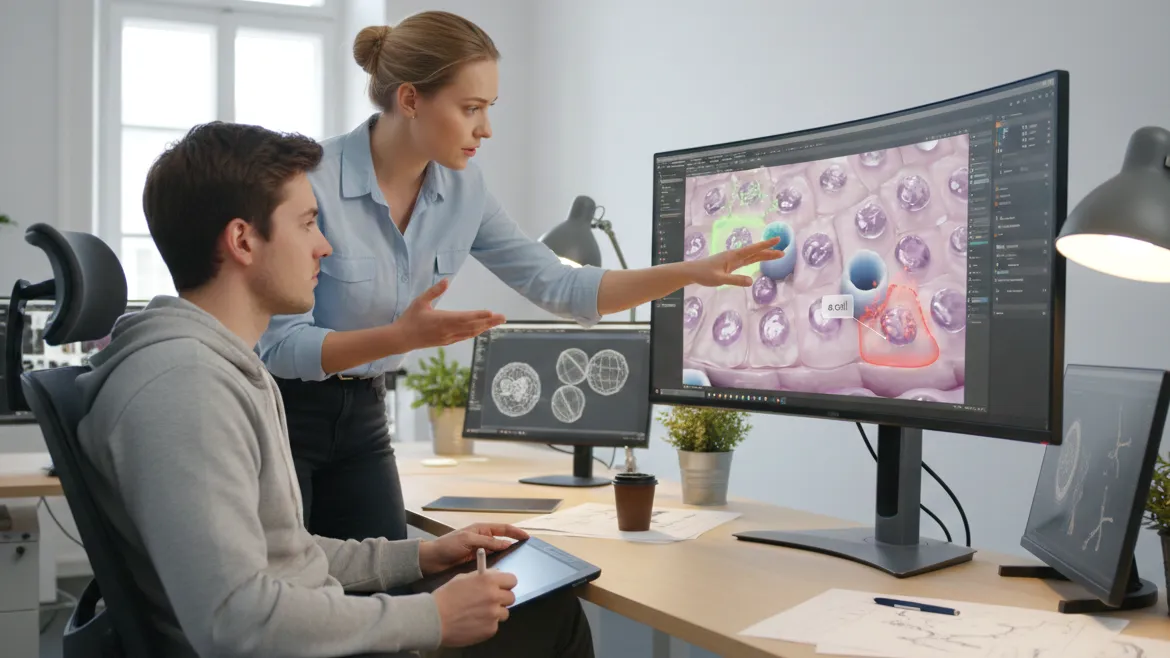
To get a rough idea of what your animation might cost, you need to figure out a few things first:
Custom or ready-made: Will you need a fully custom animation built from scratch, or can you use an existing video (or its parts) from a library?
Animation type: What kind of content do you need — a mechanism of action, a surgical procedure, a physiological process, or something else? Different types vary in complexity and production effort. For example:
-
Simple medical procedures: from $7,500/min
-
Mechanism of disease (MoD) or physiological processes: from $10,000/min
-
Surgical procedures or medical devices: from $12,500/min
-
Biotechnology processes: from $15,000/min
-
Scientific concepts or MoA animations: from $20,000/min
Duration: How long will the animation be? Pricing is typically calculated per minute, so the longer the video, the higher the overall cost. Even small differences in length can significantly affect the final budget, especially for complex 3D sequences.
Want a ballpark figure right now? Use our free 3D Medical Animation Cost Calculator to get an instant estimate based on your selections.
Why choose VOKA for medical video production?
If you need a partner for your medical animation project, this is why the VOKA team should be on your radar:
Scientific accuracy
We have an in-house team of medical experts, so you can be sure that every animation is factually correct and scientifically sound. From the production perspective, this speeds up the validation process and eliminates the need for external consultants (which often adds extra cost to the budget).
Structured process & communication
Our animation production process is structured, clear, and easy to follow. From kickoff to final delivery, you’ll always know what stage the project is in and what comes next. You’ll stay in direct contact with the animation team, and your feedback is incorporated at every key step, so there are no surprises, just a predictable workflow.
Transparent pricing
We openly discuss pricing from the very beginning and provide a preliminary estimate during the consultation stage. That way, you have a clear idea of the expected budget early on — with no hidden costs surfacing at the end of the project.
Wrapping up
Medical animation costs can vary widely, but the key takeaway is simple: accuracy saves money in the long run.
When scientific details are handled correctly from the start, when modeling and animation are planned carefully, and when expert validation happens early, you avoid expensive revisions, delays, and regulatory issues later.
Simply put, investing in a well-structured production protects your budget.
Thinking about your next medical animation? Let’s create a powerful visual story together – contact us for a quote.
FAQ
1. What affects the medical animation cost the most?
The biggest cost drivers are scientific complexity, duration, and production style. A short anatomy overview will cost far less than a surgical procedure or a detailed MoA with cellular-level visuals. Custom 3D modeling, character animation, and tight deadlines can also significantly increase the budget.
2. What is the average cost of a 3D medical animation per minute?
For professional studio-level work, the average cost typically ranges between $6,000 and $18,000 per minute, depending on complexity. Simpler explainer-style animations may fall below it.
3. Why is a medical 3D animation video cost higher than a 2D one?
3D animation requires modeling, texturing, lighting, rigging, and rendering, which makes it more time- and resource-intensive than 2D. It also allows for deeper scientific visualization, which adds production complexity.
4. Do I own the source files after the project?
Ownership depends on the licensing agreement. In many cases, clients receive the final rendered video files, while source files (such as 3D models and project files) may require a separate buyout agreement. It’s important to clarify this upfront.
5. What if I need to change the script during animation production?
Minor script edits are usually manageable during the early stages. However, significant changes after animation has started can lead to additional costs and timeline adjustments, especially if scenes need to be re-animated.
6. How long does a typical project take?
A standard 1-2 minute 3D medical animation typically takes 6-10 weeks, depending on complexity, feedback cycles, and approval processes. More complex MoA or biotech projects may take longer.

Share
Table of contents
Thank you for your comment!
Your comment has been submitted for moderation and will be published soon. We'll email you once it’s live.