

9 medical animation trends shaping healthcare communication in 2026

Share:

Copy link

Share via Telegram

Share on Facebook

Share on LinkedIn

Share via WhatsApp

Share on X

Share via Email
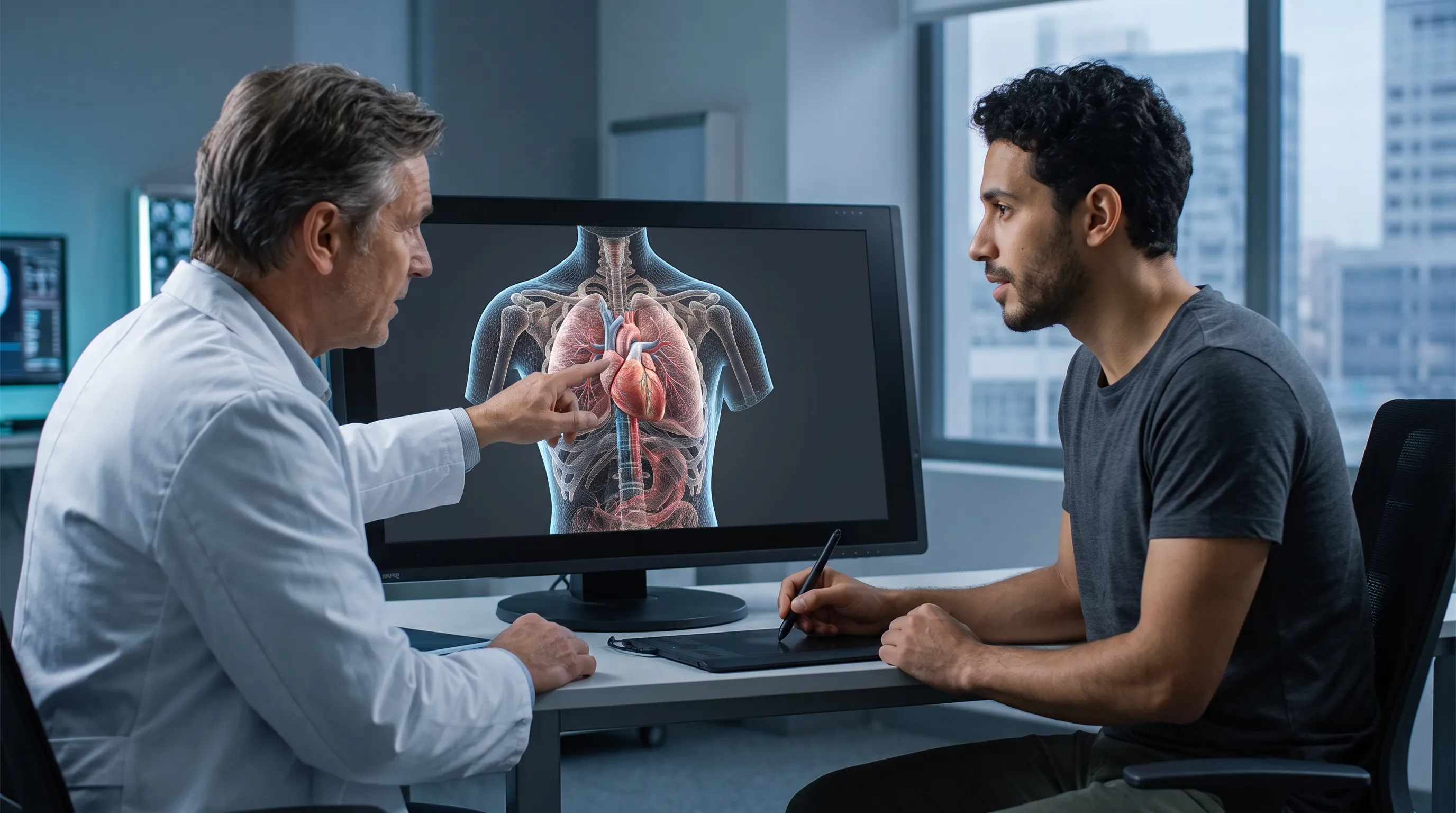
Table of contents
Medical animation has come a long way from “one video for one campaign.” AI changes parts of the production workflow, real-time rendering speeds up iteration, and interactive 3D gives audiences more ways to explore medical content.
But new does not always mean useful.
At VOKA, we work with medical visualization every day, and that gives us a practical view of what is genuinely useful and what simply sounds impressive on paper.
So, we’ve rounded up nine trends worth watching – and, more importantly, where they can make sense for healthcare communication.
Key takeaways
1.
AI, real-time rendering, interactive 3D, AR, and VR each solve different problems. The newest tool is not necessarily the right one for your project. Choose the technology based on the communication goal.
2.
Scientific accuracy remains central to medical animation. New production tools can speed up workflows, but anatomy, biological processes, scale, causality, and medical claims still require expert review.
3.
Simplified anatomy and 2D graphics can sometimes be more efficient than photorealistic imagery.
4.
The best projects are planned for their audience and future use. Patient education, HCP communication, training, and marketing content require different levels of detail, interaction, accessibility, and review.
But before considering the latest trends, let’s look at what's changing in medical animation production.
Medical animation in 2026: what’s changing?
The shift is happening across three parts of the process.
1. Production
The way 3D medical animation is produced is changing. AI accelerates concept exploration, cleanup, upscaling, and localization. Real-time rendering makes lighting, camera, and material changes easier to review. Reusable 3D assets can also reduce the need to rebuild the same anatomy, device, or biological process for every new piece of content.
2. Delivery
Medical content lives beyond a traditional video player. Interactive 3D, AR, and VR experiences give users more control over what they see and explore. But the added interaction only matters when it helps the audience understand or practice something.
3. Communication
A single 3D asset can support different versions of the same scientific story. The same medical device model or biological process can be adapted for HCP education, doctor-patient communication, sales training, investor presentations, or localized campaigns.
For healthcare organizations, this changes how a project should be planned. Instead of asking which technology is newest, start with three questions:
1
What does the audience need to understand?
2
How will they use the content?
3
Will the same assets be needed again?
The answers usually point to the right production approach.
The nine trends discussed below reflect different changes in medical video production. Some are mature practices, while others are emerging technologies that are most valuable in specific use cases.
1. AI-assisted production with human scientific oversight
AI is becoming a practical part of medical animation production, but its most valuable role is not in replacing 3D artists, animators, or medical experts. At VOKA, we see the most value in tasks that are repetitive, exploratory, or time-consuming. AI can help teams test ideas faster, prepare assets, and reduce manual work within a structured medical animation production workflow.
Where AI use is valuable
AI makes the most sense when a project requires many quick iterations or lots of time-consuming routine tasks. During early development, it helps explore visual directions, environments, and compositions. It also speeds up moodboards, storyboards, and previsualization.
Further down the pipeline, AI-assisted tools can help with image and footage cleanup, background removal, upscaling, denoising, asset preparation, translation, and voiceover.
Where AI has limits in medical animation
Medical visualization leaves little room for unsupported details. A generative tool may produce an anatomically convincing image while incorrectly placing a vessel, muscle, organ, or tissue layer. It can also introduce details that were never part of the approved scientific material.
That creates a particular risk in HCP education, clinical communication, and regulated marketing. A visual mistake may change how the audience understands a mechanism or product.
Therefore, AI-generated material needs the same careful review as any other production element. Qualified experts should check scientific sources, anatomical models, biological processes, and clinical claims.
IP, provenance, and confidentiality also matter
There is another practical issue: what information goes into the AI system?
Teams should consider how a tool handles client materials, unpublished research, confidential product information, and patient-related content. Licensing and provenance matter too. A production team should know which elements are AI-generated, licensed, client-owned, or created in-house.
So, AI works best as part of a controlled production workflow. It truly can speed up exploration and repetitive tasks. However, artists and medical experts remain responsible for the final visual and scientific result.
2. Real-time rendering is shortening review cycles
Real-time rendering changes how teams review a scene. Instead of waiting for a final render after every major adjustment, artists can see changes to lighting, cameras, materials, and environments almost immediately.
Unreal Engine is one of the tools enabling this workflow.
From our experience, the biggest advantage is not simply rendering speed. It is the ability to make decisions earlier.
A client can ask for a different camera angle, lighting setup, or material treatment and see the result during the review. Problems can be spotted before they affect a full sequence. That can reduce both review time and the cost of late revisions.
When real-time rendering makes sense
It is particularly useful when:
-
a project has several review cycles;
-
clients need to make visual decisions during production;
-
multiple camera angles or versions are required;
-
the content will eventually run in an interactive AR or VR environment.
When traditional rendering is still better
Offline rendering remains a preferable option for projects where the final image matters more than speed. This can include highly cinematic medical films or productions that rely on advanced simulations and the highest possible photorealism.
It means that the practical choice is not about real-time vs. offline but about the production priorities. If fast feedback and flexibility matter, choose real-time. If the project is built around a carefully controlled final image, a traditional pipeline may be better.
3. Interactive 3D is moving medical content beyond passive video
Interactive 3D gives users control over what they see. Instead of following a fixed camera path, they can rotate and zoom a model, isolate structures, reveal anatomical layers, or explore different stages of a process.
This works particularly well when the audience needs to examine something from several perspectives.
For example, 3D medical device animation can show how a device works, highlight individual components, and demonstrate its relationship to surrounding anatomy. An anatomy or pathology model can allow users to isolate structures and compare different states.
Interactive 3D can also be useful for sales teams. A representative can use the same model to answer different questions during a meeting instead of following a fixed presentation.
When interactive 3D is worth it
The format makes sense when users genuinely benefit from controlling the visualization. It is especially useful for:
-
medical device demonstrations;
-
anatomy and pathology education;
-
HCP presentations;
-
sales enablement;
-
complex products that need to be examined from multiple perspectives.
Things to consider before choosing it
Interactivity comes with additional production and UX cost. Detailed models need to be optimized for performance, especially on mobile and browser-based platforms. Too many controls can also make an experience harder to use.
So, the key question is: does the user need to explore the information, or simply understand it?
If a controlled narrative communicates the message more clearly, a conventional animation may be the better choice.
“The key question is not whether a project can be made interactive, but whether users benefit from controlling the visualization themselves. Interactivity should serve a clear communication purpose and remain intuitive to use. Otherwise, added controls can create unnecessary complexity rather than improve understanding.”

4. AR, VR and spatial computing are becoming practical tools

AR, VR, and spatial computing have found their roles in healthcare communication. Each format solves a different problem.
VR for training and simulation
VR creates a controlled environment for medical training simulations, allowing students and HCPs to practice procedures, explore anatomy, or work through clinical scenarios.
It makes the most sense when active practice matters. A learner can repeat a scenario instead of simply watching an explanation.
AR for devices and contextual information
Augmented reality in healthcare places digital content into the physical environment. It can help demonstrate a medical device in context, show how components work, or overlay information onto a physical object.
This can be useful for product demonstrations, field training, and certain point-of-care applications.
MR and spatial computing for presentations and collaboration
Mixed reality and spatial computing allow users to examine 3D content within a physical space. This can work particularly well for exhibitions, product presentations, collaborative reviews, and large-scale demonstrations.
A medical device, for example, can be enlarged, repositioned, and examined from different perspectives without being limited to a conventional screen.
When immersive formats are not the right choice
Immersive experiences require compatible hardware, setup, and user onboarding. That makes them harder to distribute than a video or browser-based 3D model.
If the goal is simply to explain an MoA to a large online audience, VR provides more burden than value. If the goal is to train someone to perform a procedure, the extra immersion may be exactly what the project needs.
5. One 3D asset is being repurposed across entire campaigns
A scientifically reviewed anatomy model or biological process can become the basis for several pieces of content. The same assets can support a hero animation, social clips, still images, interactive 3D, and AR experiences, helping teams improve the long-term ROI of medical animation.
This approach is especially valuable for products with long communication cycles. A device may need content for its launch, sales presentation, distributor training, conferences, and future product updates.

There are three practical advantages of reusable assets:
-
Consistency: the same approved models and visual language are used across communications.
-
Lower production effort: teams don’t need to rebuild the same assets repeatedly.
-
Faster adaptation: new formats can be created from an existing visual foundation.
However, the approach provides benefits only if content will be reused over months or years. If a project is a one-off animation with no plans for additional use, building a large reusable asset library is not necessary.
What buyers should plan from the start
If reuse matters, it should influence production decisions from the beginning. Models, materials, animations, camera setups, and scene files need to be structured so they can support future formats.
That turns the 3D production into a longer-term content investment rather than a single deliverable.
6. Personalized and audience-specific animation is growing
Here, personalization primarily means adapting content to the audience and context of use.
It implies that the same 3D content can support several versions of a communication. For example:
-
A patient version may use simpler language, less anatomical detail, and a stronger focus on understanding the treatment.
-
An HCP version can go deeper into anatomy, mechanisms, terminology, and clinical context.
-
An investor presentation may focus on the technology or product commercial opportunity.
-
A sales-training version can emphasize product benefits, key talking points, and questions a sales team may encounter.
The same principle applies to languages and markets. A reusable visual foundation can support localized narration, labels, graphics, and messaging without rebuilding the core visualization.
For buyers, this approach is most useful when one scientific concept needs to serve several audiences. It can reduce duplicate production while keeping each version relevant to its viewers.
7. Accessibility and mobile-first delivery are becoming baseline requirements
In 2026, medical animation is expected to work across more than a single presentation or desktop screen. Accessibility and mobile-first delivery are becoming part of the production planning from the beginning rather than being added after the animation is finished.
This includes:
-
Subtitles and transcripts for users who can’t or prefer not to use audio.
-
Voice-over and multilingual versions for different audiences and markets.
-
Clear visual hierarchy so that the main message remains easy to follow.
-
Sufficient color contrast and readable typography.
-
Visual cues that do not depend on color alone, which is especially important for labels, diagrams, and interactive elements.
-
Mobile-specific versions where small-screen viewing makes detailed anatomy or fine labels difficult to read.
-
Lightweight delivery to reduce loading times and maintain a usable experience on slower connections or less powerful devices.
Mobile delivery deserves particular attention. Detailed anatomy that works well on a large presentation screen can become difficult to read on a phone. Labels may need to be larger, compositions simpler, and sequences shorter.
Accessibility also affects international distribution. Subtitles, transcripts, and localized versions can make the same content useful across more markets.
8. Scientific accuracy, transparency, and compliance are becoming differentiators
At VOKA, scientific accuracy is part of the production process from the start. That means working from approved sources, checking anatomical and biological details, and separating scientific evidence from the way that evidence is visualized.
Key production considerations typically include:
-
Approved scientific references;
-
Medical, legal, and regulatory review where required;
-
Clear version control;
-
Documented changes and approvals;
-
Careful review of AI-generated elements;
-
Accurate representation of scale and biological relationships.
The required level of scrutiny also depends on the communication context:
-
Education can simplify complex science for easier understanding.
-
Marketing needs to avoid visuals that imply unsupported product benefits.
-
Regulated claims require evidence and the appropriate review and approval process.
The closer an animation gets to communicating a specific clinical or product claim, the more important documented evidence and scientific review become.
9. Stylization and storytelling complement photorealism
Photorealistic rendering remains valuable for medical animation. However, greater realism doesn’t automatically produce better communication. Highly detailed images can sometimes increase cognitive load. It is harmful in cases when audiences need to understand a complex biological process rather than simply observe anatomical detail.
Stylized rendering can reduce visual noise and direct attention toward the structures or processes that matter. Useful techniques include:
-
Simplified materials and textures to reduce unnecessary detail.
-
Controlled color and contrast to distinguish structures or highlight a mechanism.
-
Selective transparency and isolation to reveal relationships between anatomical layers.
-
Intentional visual exaggeration when it improves comprehension without changing the scientific meaning.
-
Consistent visuals across a series so viewers can quickly recognize important structures and processes.
Storytelling can reinforce these techniques. For example, a sequence might move from a macro view of the body to an organ, tissue, cell, and molecular interaction. It gives viewers spatial context before introducing microscopic detail.
Another effective approach is combining 3D animation with 2D motion graphics. 2D labels, diagrams, timelines, data visualizations, and callouts can explain relationships that would otherwise require excessive 3D detail.
Which medical animation trends matter for your project?
Not every medical animation project needs the latest production technology. The right approach depends on the communication goal, audience, distribution environment, and production constraints.
The following table can quickly help identify which approaches are most relevant:
Some projects will combine several approaches. A medical device launch, for example, could use reusable 3D assets as the foundation for an animation, AR demonstration, and localized sales materials.
Other projects need much less. A short patient video may be more effective as a straightforward, carefully produced animation. It means that the technology should follow the communication needs.
“Before selecting a production method, consider three questions: What does the audience need to understand? How will they experience the content? And how many times will the assets need to be reused or adapted? These questions usually provide a more useful starting point than choosing a technology simply because it is currently trending.”

How to prepare for a future-ready medical animation project
The most useful production decisions are often made before modeling starts.
Therefore, we prepared the following project checklist of pre-production measures:
1
Clarify who will watch the content and what they should understand, decide, or do afterward.
2
Differentiate information that benefits from either 3D visualization or 2D graphics and text.
3
Establish the references, subject-matter experts, and medical, legal, or regulatory reviewers involved in approval.
4
Consider still renders, short social cuts, interactive models, AR experiences, training materials, or event content that may use the same 3D assets.
5
Use conventional animation when a controlled narrative is vital. Consider interactive 3D, AR, or VR when users benefit from active participation.
6
Plan subtitles, transcripts, voiceover, readable labels, mobile versions, and language adaptations.
7
Establish how client materials, licensed assets, confidential information, and AI-assisted production tools can be used.
8
Structure models, materials, animations, and scenes so they can support future versions and communication channels.
9
Decide how success will be measured. It can be project-specific KPI such as completion rate, engagement, conversions, or training performance.
The earlier these decisions are made, the easier it is to build an efficient production pipeline.
Conclusion: The future of medical animation
As healthcare communication becomes more complex and more distributed across channels, the value of 3D visualization comes from scientific accuracy, adaptability, and interactivity.
The strongest projects are designed as flexible visual systems rather than one-off videos. A scientifically reviewed 3D asset can support different audiences, languages, formats, and communication contexts while reducing the need to rebuild content from scratch. At the same time, technologies such as AI, real-time rendering, interactive 3D, and spatial computing can make production and delivery more flexible.
However, all these tools should solve a certain communication need. For healthcare organizations, the starting point should be the communication objective and content strategy, not the technology itself.
If you are planning a medical animation project and want to determine which production approach, formats, and reusable 3D assets make the most sense, VOKA can help you evaluate the options and build a workflow around your scientific and communication requirements.
FAQ
1. What are the latest trends in medical animation?
Key trends include AI-assisted production, real-time rendering, interactive 3D, AR/VR and spatial computing, audience-specific content, accessibility and mobile-first delivery, and reusable 3D assets. The most relevant combination depends on the project's audience, communication goal, distribution channels, and need for future adaptation.
2. How is AI used in medical animation?
AI can speed up concept development, storyboarding, cleanup, upscaling, asset preparation, localization, and other repetitive tasks. It is most useful when it reduces manual work or helps teams explore ideas faster.
3. Will AI replace medical animators?
Not in the near future, and not in all projects. AI can automate or accelerate specific tasks. However, effective medical animation still requires scientific accuracy, narrative judgment, art direction, and expert review.
4. How are AR and VR used in medical animation?
VR is particularly useful for training, simulation, and scenario-based learning. AR can support medical device demonstrations and overlay digital information onto the physical environment. MR and spatial computing can be used for product presentations, exhibitions, and collaborative exploration of 3D content.
5. What is interactive medical animation?
Interactive medical animation allows users to explore a 3D model instead of following a fixed sequence. They may rotate or zoom the model, isolate structures, reveal layers, or activate specific information.
6. How can one 3D model be reused across a healthcare campaign?
A reviewed master model can become the basis for animation, still images, social content, interactive 3D, AR, exhibition materials, and training assets. This can improve consistency and reduce the need to rebuild the same anatomy, device, or biological process for every new deliverable.
Make VOKA your preferred source
See more VOKA articles in Google Search

Share
Table of contents
Thank you for your comment!
Your comment has been submitted for moderation and will be published soon. We'll email you once it’s live.