

Outsourcing medical animation: benefits, challenges, and top providers

Share:

Copy link

Share via Telegram

Share on Facebook

Share on LinkedIn

Share via WhatsApp

Share on X

Share via Email
Table of contents
Sooner or later, most pharma and biotech teams reach a point where they need medical animation. It might be a product launch, an investor presentation, or a congress. But at that moment, deadlines are tight, the science is complex, and in-house production is often too slow and expensive.
This is why companies choose to outsource medical animation. The right partner can help deliver scientifically accurate content faster and more efficiently.
At VOKA, we've helped organizations outsource medical animation for years, so we've seen what works and what doesn't. In this guide, we'll explore the benefits and challenges of outsourcing medical animation, compare leading providers, and share practical tips for choosing the right partner.
Why outsource medical animation instead of building an in-house team?
Once you've decided that you need medical animation, a new question emerges: should you produce it in-house or partner with an external studio?
Many companies are tempted to build their own visualization team. The idea of full control over production, resources, and content available on demand sounds attractive. However, the reality is far more complex and expensive.
Here, we break down what it actually takes to create an in-house team and explain why outsourcing remains the go-to approach for many healthcare teams.
The hidden challenges of building an in-house studio
It’s easy to underestimate how costly and resource-heavy content production can be in pharma and biotech. Some of the most common challenges include:
-
Finding specialized talent. Medical animation requires professionals who combine advanced 3D skills with a strong understanding of anatomy, physiology, pathology, and scientific communication. These specialists are difficult to find and expensive to hire.
-
High infrastructure costs. Producing detailed medical animations requires powerful rendering hardware, data storage solutions, and ongoing technical support.
-
Expensive software licenses. Professional medical visualization often relies on multiple software packages for modeling, animation, simulation, rendering, and post-production, all of which require subscription fees.
-
Limited medical expertise. Small internal teams may lack access to dedicated medical specialists or subject matter experts. Lack of their guidance increases the risk of inaccuracies in MoA, MoD, or physiological visualizations.
-
Long setup and onboarding. Recruiting specialists and building production pipelines can take many weeks before the team becomes operational.
Given these challenges, it’s worth comparing in-house production with outsourcing to better understand the trade-offs between cost, speed, and access to expertise.
In-house vs. outsourcing: side-by-side comparison
The following table summarizes key criteria for choosing between in-house and outsourced teams.
For most companies, outsourcing is a faster and more flexible option. It gives them access to specialized expertise without the costs and complexity of building an internal team. Consequently, they can focus on their core business values and activities.
How to choose a medical animation outsourcing partner?
Not all animation studios can handle the requirements of healthcare content production. Before selecting a vendor, you should evaluate potential partners against several critical criteria.
Scientific accuracy
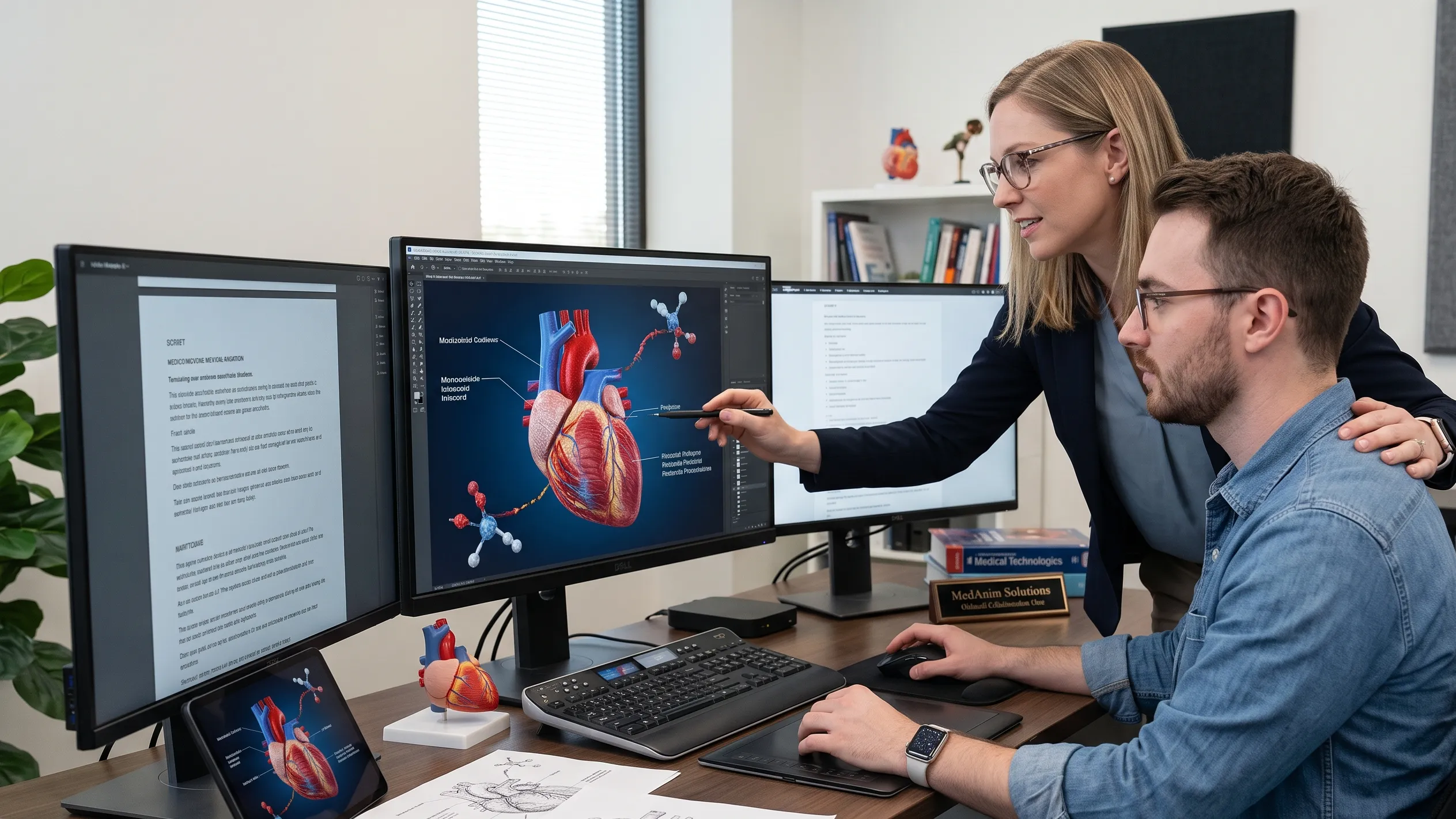
Visual quality alone is not enough. Outsourcing only works when the vendor understands the science. If your team constantly has to explain concepts and correct details, the process becomes slow and inefficient.
The right partner should be able to translate complex scientific information into accurate visuals with minimal oversight.
Look for providers that employ medical consultants or in-house healthcare experts. Their work ensures that anatomy and biology are accurate and align with current scientific knowledge.
Regulatory and MLR readiness
Medical animations often pass through Medical, Legal, and Regulatory (MLR) review before publication. Agencies unfamiliar with this process may cause unnecessary revision cycles and compliance concerns.
Experienced medical animation providers understand the importance of reference management and regulatory requirements. They know how to build content that supports smoother reviews and minimizes the risk of major revisions late in production.
For highly regulated industries such as pharmaceuticals, MLR readiness is often as important as creative capability and scientific accuracy of the content.
Production efficiency
One of the biggest benefits of applying to a specialized medical visualization company is the availability of pre-built assets.
Agencies like VOKA maintain extensive libraries of anatomical structures, pathological conditions, organs, tissues, cells, and biological systems. Instead of creating every model from scratch, production teams can leverage existing validated assets and customize them for a specific project.
This approach offers several advantages:
-
Faster project delivery;
-
Lower production costs;
-
Greater scientific consistency;
-
Easier scaling across multiple projects.
Proven healthcare experience
Not every animation company understands the unique requirements of the healthcare industry. Review a potential partner's portfolio carefully and look for experience in pharmaceutical marketing, medical education, congress communications, and healthcare training.
A partner that has successfully delivered content for these needs is better equipped to support complex projects.
Cost of outsourcing medical animation
Unlike general marketing videos, medical animations often require input from medical experts, scientific consultants, 3D artists, scriptwriters, and regulatory reviewers.
As a result, pricing is influenced not only by animation length but also by the amount of scientific research and validation involved.
Key factors that influence cost
Several factors have the greatest impact on the final project budget:
-
Scientific complexity. A basic anatomy visualization typically requires less effort than a detailed MoA or molecular interaction animation.
-
Level of customization. Projects built from scratch usually cost more than those leveraging existing asset libraries.
-
Medical imaging requirements. Projects involving CT, MRI, ultrasound, or DICOM data often require specialized segmentation and modeling workflows.
-
Review and approval cycles. Multiple rounds of legal and regulatory reviews and feedback loops can extend production timelines and increase costs.
-
Localization needs. Multi-language voiceovers, subtitles, and regional adaptations may require extra production work.
There is no fixed price for medical animation. Based on the projects we've delivered, professionally produced pharmaceutical, biotech, and medical device animations typically fall within the $10,000-20,000 per finished minute range.
For a more detailed cost breakdown, see our comprehensive guide to medical animation costs or use our calculator to estimate your project.
Top outsourcing medical animation companies
In this section, we list several agencies that both specialize in medical content outsourcing and provide a wide range of services.
VOKA
VOKA is a MedTech company that develops scientifically accurate medical and scientific animations, high-quality 3D anatomical models, and advanced immersive solutions. Our clients are pharmaceutical, biotech, medical device, and educational organizations.
What differentiates the company is its ability to enable clients to use the same scientific assets across videos, web experiences, training platforms, and educational applications. Companies often choose VOKA for its focus on scientific accuracy and visualization scalability.
Strengths
-
Extensive library of medically validated anatomical and pathological 3D assets.
-
Faster and more cost-efficient production thanks to reusable asset libraries.
-
Strong expertise in converting CT, MRI, and DICOM data into detailed 3D models.
-
Expertise in the development of AR & VR solutions.
-
In-house medical team taking part in all the stages of video creation.
-
Award-winning experience in scientific and medical video production.
Weaknesses
-
May not be ideal for projects that prioritize artistic experimentation over scientific accuracy.
-
Less suitable for brands seeking entertainment-focused visualizations.
Microverse Studios
Microverse Studios is a medical animation company that creates high-quality molecular, cellular, and MoA animations for biotechnology and pharmaceutical companies.
The studio is famous for producing scientific visualizations with cinematic production quality.
Strengths
-
Exceptional visual quality and molecular-level detail.
-
Content specifically tailored for investor presentations, fundraising campaigns, and pharmaceutical brand positioning.
-
Strong expertise in MoA and molecular storytelling.
-
Proven record of creating premium-quality visuals for innovative biotech and life science companies.
Weaknesses
-
Premium pricing compared with many competitors.
-
Longer production timelines due to highly customized production workflows.
-
May not be the best fit for projects requiring quick results or large volumes of content.
3DforScience
3DforScience is a scientific communication agency that specializes in the production of medical animations and immersive technologies such as augmented reality, virtual reality, and interactive digital experiences.
The company works across healthcare, pharmaceuticals, biotechnology, and medical device sectors.
Strengths
-
Broad range of services beyond traditional animation.
-
Expertise in AR, VR, and interactive scientific communication.
-
Strong capabilities in healthcare product launch support.
-
Offers both educational and promotional content for a variety of healthcare audiences.
Weaknesses
-
Workflows can be more complex than necessary for straightforward animation needs.
-
Not the fastest option for clients seeking simple deliverables on tight timelines.
Flatworld Solutions
Flatworld Solutions is a video production outsourcing provider with a broad range of services. They work on medical animation production, software development, engineering, and financial support.
The company is particularly attractive for organizations that require high production volumes and cost-efficient content creation.
Strengths
-
Reasonable pricing for large content portfolios.
-
Specializes in producing content for patient education, healthcare awareness campaigns, and internal training materials.
-
Ability to handle large volumes of projects simultaneously.
-
Scalable production infrastructure suitable for enterprise-level organizations.
Weaknesses
-
Less specialized in advanced medical and scientific visualization than dedicated healthcare animation studios.
-
Limited focus on complex molecular or cellular-level animations.
-
May not provide the level of scientific depth required for sophisticated MoA or pathology-focused projects.
Common mistakes when outsourcing medical animation
Outsourcing medical animation can significantly accelerate content production and give teams access to specialized expertise. However, after working on hundreds of projects, we've noticed similar issues repeatedly.
Here are some of the most common mistakes that can sabotage a successful project.
Bringing MLR teams into the process too late
One of the most frequent reasons for delays is involving Medical, Legal, and Regulatory reviewers only after scripts or animations have already been developed.
At that stage, even small compliance concerns can trigger extensive revisions.
"In our experience, projects run more smoothly when MLR teams are involved during script development rather than only at final review. Early alignment at this stage prevents late-stage bottlenecks and helps keep production timelines predictable."

Starting production before key messages are formulated
Many projects begin without agreement on the specific messages the animation must communicate.
As a result, stakeholders often interpret the project's objectives differently, leading to inappropriate feedback and multiple revision rounds.
Before production starts, your company and the vendor should agree on:
-
Primary communication objectives;
-
Core scientific messages;
-
Audience needs;
-
Success criteria.
A few extra planning sessions at the beginning can save weeks of revisions and editing.
Treating the animation as a one-time asset
Many organizations create an animation for a specific event or presentation. But they rarely consider how the content could support future initiatives.
In practice, a well-designed animation can often be adapted for:
-
HCP education programs;
-
Sales enablement materials;
-
Product launch campaigns;
-
Investor communications;
-
Internal training;
-
Digital marketing activities.
Planning for reuse early typically delivers a much higher return on investment.
Choosing a vendor based on price alone
Budget is always an important factor. However, selecting a provider solely because they offer the lowest price can create additional costs later in the project.
Medical animation requires a combination of scientific expertise, production capability, and healthcare industry experience. When any of these elements are missing, teams often face additional revisions, extended approval cycles, and increased client involvement throughout production.
"In practice, we often see that the most expensive projects are not the ones with the highest production rates, but the ones where clients have to constantly step in to fix scientific or structural issues that the vendor wasn’t able to resolve independently. A strong partner should be able to take ownership of both the visual and scientific execution, so the client can focus on decisions rather than corrections."

Conclusion
Medical animation outsourcing provides immediate access to specialized talent, reduces operational overhead, and enables scaling production to meet business needs.
However, not all providers are equipped to support the scientific and regulatory demands of healthcare communications. Choosing the right partner means finding a team that understands both the science of your product and the business objectives of your project.
At VOKA, we help organizations create scalable medical visualization assets that can be reused across education, marketing, training, product launches, and interactive experiences.
If you're ready to outsource your medical animation, let’s discuss your goals and explore how we can bring your next vision to life.
FAQ
1. Why do companies outsource medical animation?
Most pharmaceutical, biotech, and healthcare companies outsource medical animation to gain access to specialized expertise without investing in an in-house production team. Outsourcing provides access to scientific consultants, 3D artists, and established workflows while reducing infrastructure, software, and staffing costs.
2. Is outsourcing medical animation more cost-effective than building an in-house team?
In most cases, yes. Building an internal studio requires significant investments in talent acquisition, software licenses, rendering hardware, training, and ongoing operational expenses. Outsourcing allows companies to pay only for the projects they need while leveraging existing expertise and production infrastructure.
3. How much does outsourced medical animation cost?
The cost depends on factors such as scientific complexity, animation length, customization level, medical imaging requirements, and regulatory review cycles. High-quality pharmaceutical and biotech animations typically range from $10k to $20k per minute, although highly specialized projects may require larger budgets.
4. How long does it take to produce a medical animation?
Production timelines vary depending on project scope and review requirements. Most professional medical animation projects take between 6 and 18 weeks, including scripting, storyboarding, animation production, scientific validation, and approval cycles.
5. Can outsourced medical animation support pharmaceutical product launches?
Yes. Medical animations are widely used throughout the launch process, including disease awareness campaigns, HCPs and KOLs education, congress presentations, sales enablement, investor communications, and internal training programs.
Make VOKA your preferred source
See more VOKA articles in Google Search

Share
Table of contents
Thank you for your comment!
Your comment has been submitted for moderation and will be published soon. We'll email you once it’s live.