

A&P study guide: how to pass your anatomy and physiology exams

Share:

Copy link

Share via Telegram

Share on Facebook

Share on LinkedIn

Share via WhatsApp

Share on X

Share via Email

Table of contents
Anatomy and physiology (A&P) can be challenging because you need to learn a large amount of terminology, understand how body systems work, and imagine all that in three dimensions. And last-minute cramming is rarely enough here.
Whether you're taking A&P 1 and 2 as a nursing or pre-health prerequisite or studying anatomy in medical school, the same principles apply. In this guide, VOKA’s medical experts share study strategies they have used as students and continue to use when teaching and reviewing anatomy with learners. You’ll find a practical A&P study plan, memorization techniques, and tips for preparing for exams.
How to prepare for anatomy & physiology: a step-by-step plan
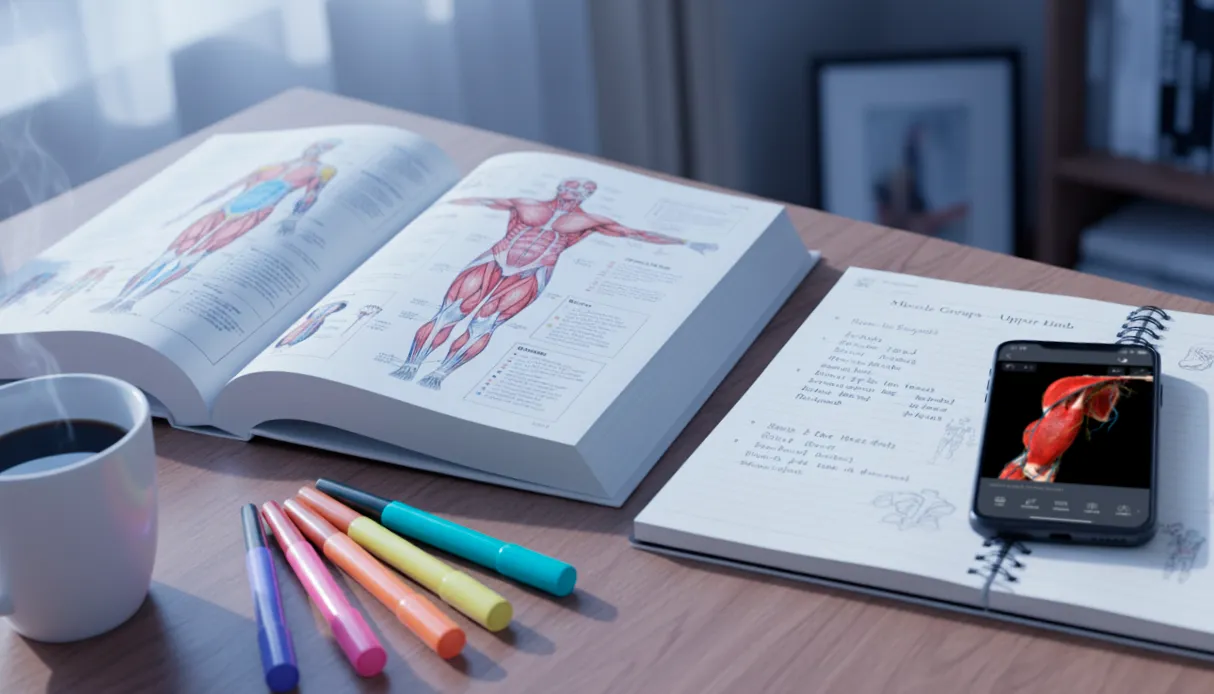
We’ve all been guilty of putting off studying until the night before an exam. However, that’s not a strategy for A&P success.
Here’s a simple step-by-step plan to help you stay organized:
Step 1: Map out the course
Start with your syllabus and exam schedule. List the main body systems and topics you need to cover, then identify which ones will be tested.
Pay attention to:
-
topics covered in each lecture or class;
-
practical and written exam dates;
-
topics that carry more weight in your final grade;
-
areas you already find difficult.
This gives you a clear picture of what you need to learn instead of trying to study everything at once.
Step 2: Gather your study resources
Choose a small set of A&P resources rather than collecting everything you can find.
Your study materials might include:
-
your lecture notes and textbooks;
-
reliable medical reference resources;
-
anatomy and physiology videos;
-
quizzes and practice questions;
-
flashcards;
-
anatomy apps and 3D visualization tools.
This way, you won’t waste time searching online every time you need to review something.
Step 3: Set weekly study times
Break the material into regular study sessions instead of leaving the entire course until the last few days before an exam.
For example, you could dedicate separate sessions to:
-
previewing the next chapter's headings and diagrams before the lecture;
-
learning a new body system;
-
reviewing terminology;
-
practicing diagrams and identification;
-
answering questions;
-
reviewing topics you previously studied.
Keep your schedule realistic. A study plan that you can follow consistently is more useful than one that looks perfect on paper but is difficult to maintain.
Step 4: Review often
Don't wait until the exam to find out that you've forgotten something.
Return to previously studied material during the week. Use quick quizzes, flashcards, blank diagrams, or short explanations to test what you still remember.
When you get something wrong, don't just memorize the correct answer. Find out why you made the mistake and add that topic to your next review session.
Step 5: Track progress and adapt
Keep a checklist of what you’ve mastered and what’s tricky. Spend extra time on tough topics. You can also add extra resources like videos or guides to streamline studying and memorizing anatomy and physiology.
If a topic still doesn't make sense, get help early: go to your instructor's office hours, ask a tutor, or join a study group before the first big exam, not after it.
Tips for studying anatomy & physiology
With a clear roadmap in place, it’s time to explore practical ways to study anatomy and physiology smarter.
What research says about the best study methods
Not all study methods work equally well. In a large review of 10 popular learning techniques, Dunlosky et al. (2013) rated two of them as highly useful: practice testing (testing yourself) and distributed practice (spreading study sessions over time). Highlighting and rereading received low ratings, and the authors recommend replacing rereading with practice testing.
What about learning styles? A review by Pashler et al. (2008) found no adequate evidence to support tailoring instruction to a person's "learning style." Visual tools help in A&P because the subject itself is spatial, not because some students are "visual learners."
That's why the tips below focus on testing yourself, reviewing regularly, and working with visuals.
Using visual tools
Visual learning is one of the best ways to study anatomy and physiology. It helps you see abstract concepts and better grasp how the body works.
The most useful visual tools at this point are 3D models of anatomy and biomechanics. With these, students can zoom, rotate, hide layers, or virtually dissect structures to really grasp how everything fits together.
For easier studying, you can download our VOKA 3D Anatomy & Pathology app to your mobile device. It puts a large collection of models at your fingertips, so you can explore and review them anytime, even on your way to an exam.
Explore the human body in 3D with VOKA
Try the appIn addition to models, you can watch dynamic medical videos to explore physiological processes in motion.
Connecting structure with function
In anatomy and physiology, structure and function go hand in hand. Every part of the body exists for a reason.
When you study an organ, tissue, or system, ask yourself: “What does this do?” and “How does it work this way?”
For example, the tiny alveoli in the lungs are easy to remember once you think about how their thin walls let oxygen pass into the blood. Connecting how something looks to what it does makes understanding much easier.
The hardest A&P topics and how to study them
Students often name the same few topics as the hardest in A&P. Here's why they cause trouble and how to approach them.
“I found head and neck anatomy particularly difficult in my first year of medical school. There were so many nerves, muscles, and blood vessels packed into a small area, and it was hard to understand how they related to one another from textbook illustrations. But all this is essential in dentistry, where even small anatomical differences can matter during procedures and when administering local anesthesia.”

Applying knowledge
Studying A&P is about using what you learn. Test yourself with case studies, “what if” scenarios, or mini-experiments.
Here’s how you can apply your knowledge:
-
Teach a concept to someone else (even a teddy bear works!).
-
Connect theory to observations of your own body, like noticing muscle movements or heartbeats during exercise.
-
Ask “what happens if?” For example, what changes if blood flow is blocked or a muscle is injured?
Active use of knowledge strengthens memory and builds confidence for labs and exams.
Regular review sessions
Cramming may get you through a quiz, but long-term mastery requires consistent review. So, make short, weekly sessions part of your routine.
Here’s what you can do:
-
Test yourself: After reading, take quick quizzes to reinforce new information.
-
Keep a review log: Track which topics feel weak and need extra attention.
-
Focus on weak areas: Return to challenging topics regularly.
If you're looking for a platform that combines expert medical content and self-testing, VOKA Wiki is a great option. It features articles supported by high-fidelity visuals, a one-click option to open an article in the AI assistant of your choice (ChatGPT, Perplexity, Claude, and others) to clarify concepts as you read, and built-in anatomy quizzes to check your knowledge right away.
Tips for memorizing anatomy & physiology
A&P is full of long, weird words and complex systems. The good news? Several A&P memorization tricks can help you stick all that info in your head. Here are five techniques that work well together.
Example of *mnemonics: The rotator cuff muscles can be remembered as "SITS" – Supraspinatus, Infraspinatus, Teres minor, Subscapularis.
"Back in med school, I loved making flashcards. My little trick? I kept easy ones in one pile, the tricky ones in another, and spent extra time on the hard ones. Focusing on cards with my weak spots made a huge difference when exams rolled around."
How to prepare for A&P exams

Every exam has its own rules. Even if you know the material well, you still need to prepare for the specific format. Here’s what to focus on:
Understanding the exam format
Before you start studying, figure out what to expect. Say, a lab exam where you identify structures on models is very different from a multiple-choice test.
So, different formats require different preparation.
-
Check question types: Multiple choice, labeling, short answers, or practical tasks.
-
Study smart: Spend more time on important sections that carry more points.
-
Practice the format: Learn to label structures or write short answers — whatever you’ll face on the exam.
How to prepare for the A&P lab practical
In a lab practical, structures are marked on models, specimens, or slides, and you move between stations with limited time to name each one. Some courses call it a "pin test." The exact format varies, so ask your instructor what to expect.
To prepare:
-
Hide the labels. Cover the labels on diagrams, or hide them in a 3D app, and name each structure before you check.
-
Change the angle. On the exam, a model may be turned differently than in your textbook, so practice recognizing structures from several views.
-
Simulate the stations. With classmates, set up a few "stations" and give each other one minute per question.
-
Use open lab time. If your school allows it, review the actual lab models before the exam.
In the VOKA 3D Anatomy & Pathology app, you can isolate, hide, and rotate structures, which makes it easy to practice this kind of identification. For terminology, try the quizzes on VOKA Wiki.
Training with mock exams
How to build confidence for the exam day? The easiest way to get ready is to simulate it, and here’s how:
-
Hunt down old exams, online quizzes, or question banks to see what’s usually asked.
-
Set a timer and do full practice tests like the real exam to check your pacing.
-
Don’t skip it when you get something wrong. Figure out why, so you don’t repeat the same mistakes.
Time management during the exam
Even if you know the material, poor time management can hurt your performance. Figure out a plan to maximize your score.
-
Quickly scan the entire exam before starting to get a sense of structure and questions.
-
Allocate time per section, leaving more for complex questions.
-
Flag difficult questions to return to later if time allows.
Mental and physical prep
Your brain works best when your body is happy. Don’t skimp on sleep, eat well, drink enough water, and get a little movement. Even a short walk can help you think more clearly.
Before an exam, take a moment to relax and calm your mind.
“Before exams, I used a simple breathing trick: inhale for 4 seconds, hold for 4, and exhale for 6. A few rounds like this really helped me calm down and focus.”

Stretch, roll your shoulders, and shake out tension. Managing stress is just as important as memorizing facts — it helps you access everything you’ve studied.
Common mistakes that make students fail A&P
Most students who struggle in A&P don't lack ability. They fall into a few common traps:
-
Only rereading slides and notes. It feels productive, but testing yourself works much better.
-
Falling behind in the first weeks. Each topic builds on the previous one, so gaps grow quickly.
-
Memorizing without understanding. Learning names without linking structure to function makes physiology questions much harder.
-
Skipping labs. Labs are where you learn to identify structures for the practical exam.
-
Waiting too long to ask for help. Go to office hours or a tutor as soon as a topic stops making sense.
-
Overloading the semester. Taking A&P alongside several other lab-heavy courses leaves little time for regular review.
Your A&P cheat sheet
We hope our tips will help you study anatomy and physiology smarter and feel less stress during exams.
For a quick reference, we’ve compiled everything into a concise table — a handy guide you can check before study sessions or right before an exam.
Build a study routine that works for you
There is no single study technique that works for every A&P student.
A good starting point is to combine understanding, active recall, visual learning, and regular review.
Break the course into manageable topics, connect anatomy with physiology, practice retrieving information without your notes, and spend extra time on the areas you find difficult.
And don't wait until the week before the exam to discover what you don't know.
For an extra boost, you can try VOKA 3D Anatomy & Pathology. Our team designed this 3D atlas specifically for students so that you can study anatomy and physiology with interactive tools anytime, anywhere!
FAQ
1. Is A&P the hardest class?
For many students, A&P is one of the most demanding courses in their program because of the volume of material, but how hard it feels depends on your preparation and how regularly you study.
2. Why is anatomy and physiology so hard?
A&P can feel overwhelming because there's a ton of new terms, you need to picture structures in 3D, and you have to understand how different systems work together. Each topic also builds on the previous one, so falling behind early makes the rest of the course harder. The good news? With the right study strategies and visual tools, it's manageable.
3. Why is it important to learn anatomy and physiology?
Anatomy and physiology give you the foundation for everything in medicine and health sciences. Knowing how the body is built and how it works helps you in labs, in the clinic, and on exams. Basically, it's the stuff you can't skip if you want to succeed in a medical career.
4. Why do we study anatomy and physiology together?
We study them together because you can’t really understand one without the other. Knowing what something looks like (anatomy) makes it much easier to see how it works (physiology). Learning them side by side just makes everything click.
5. How many hours should I study for A&P?
A common college guideline is two to three hours of study per week outside class for each credit hour, as Wichita State University recommends. For a 4-credit course, that means about 8-12 hours a week. Short daily sessions work better than a few long ones before the exam.
6. How to prepare for anatomy and physiology on your own?
Studying A&P solo works best if you have a plan. Break the course into body systems, set a weekly schedule, and revisit material regularly. Use textbooks, flashcards, and the best anatomy apps to see the structures. Mix in memory tricks like mnemonics and chunking, track your progress, and tweak your plan for the topics that give you the most trouble. Test yourself often, for example, with 3D models and the quizzes on VOKA Wiki.
7. How to study anatomy and physiology for nursing?
The overall approach is the same, but the focus is different. Nursing courses usually emphasize how systems relate to patient care: symptoms, vital signs, and how the body responds to treatments. Use visuals, practice with case scenarios, and try explaining concepts in simple terms as if you're talking to a patient. For more tips, see our guide on A&P for nursing students.
8. What is the fastest way to memorize anatomy and physiology?
Test yourself and review at increasing intervals instead of rereading your notes. Break long terms into word roots, use mnemonics for lists, and draw structures from memory. Our guide on how to memorize anatomy and physiology covers these techniques step by step.
9. What should I do if I fail an A&P exam?
First, look at which questions you missed and why: was it terminology, understanding processes, or identifying structures? Talk to your instructor as soon as possible and ask what to focus on. Then change how you study: replace rereading with self-testing, review a little every day, and see the common mistakes above.
Make VOKA your preferred source
See more VOKA articles in Google Search

Share
Table of contents

Thank you for your comment!
Your comment has been submitted for moderation and will be published soon. We'll email you once it’s live.