

Dental marketing strategies: channels, costs and ROI

Share:

Copy link

Share via Telegram

Share on Facebook

Share on LinkedIn

Share via WhatsApp

Share on X

Share via Email

Table of contents
Dental marketing is a tricky thing. The market is crowded, patients have plenty of options, and even a phone that rings all day doesn’t guarantee a full schedule. That’s partly because dental patients rarely make decisions based on logic alone. Their choices can be shaped by pain, urgency, cost, and personal preferences, sometimes all at once.
To address that, your dental marketing strategies should bring in the right patients, turn their interest into appointments, and give them enough confidence to move forward with treatment.
What does that look like in practice? In this guide, we’ll explain what dental marketing channels you should use, how to measure the ROI of your marketing efforts, and what to fix when the marketing is working but the schedule still has gaps.
Key takeaways
1.
Marketing for dentists is more than advertising. Content, local search, reviews, referrals, and internal marketing all have a role to play.
2.
Choose channels based on your goals. Give each channel a specific job instead of trying to be everywhere at once.
3.
Measure what happens after the click. Booked appointments, treatment acceptance, reactivated patients, and ROI matter more than impressions alone.
4.
Do not overlook the patients already in your practice. Recall, referrals, and unscheduled treatment can be some of your easiest growth opportunities.
Dental marketing strategies by channel
Dental practice marketing goes well beyond paid campaigns and social media posts. It can also include patient education, local search, online reputation, internal and referral marketing, as well as offline promotion.
These channels play a different role, but they share the same goal: attract the right patients and turn interest into conversion.
Before we look at each channel in detail, check out a quick comparison.
Now let’s take a closer look at each one, with practical dental marketing tips for every channel.
Patient education content
Educational content works in two directions: it helps a dental practice answer patient questions when they search and explain treatment once they are in the practice. Such content can include procedure pages, educational articles, treatment explainers, and visual content like dental animations.
It’s one of the marketing channels that keeps working after the initial effort is done. A useful procedure page or a video explainer can bring in traffic and support treatment conversations for years, while an ad stops working as soon as the budget runs out.
How to make educational content work:
-
Turn common patient questions (cost, pain, recovery time, insurance, alternatives, and what to expect) into useful content.
-
Create visual explanations for the procedures that drive a significant share of your revenue, such as implants, root canal treatment, periodontal care, or orthodontics.
-
Reuse the same visual in the treatment-plan conversation, on the procedure page, and across your social channels.
-
Use the words patients search for in addition to clinical terminology. For example, use “gum disease” alongside “periodontitis.”
-
Review procedure pages regularly so information doesn’t become outdated.
Common mistake: Creating content for other dentists instead of patients, then relying on a verbal explanation once the patient is already in the chair.
So, where can you get the information and tools to create this kind of content? Here are a few resources that improve research, design, and medical visualization.
-
Google Search: use the “People also ask” section for each procedure query to find the questions patients are already asking.
-
Google Trends: check whether interest in a procedure changes seasonally before planning your content calendar.
-
MouthHealthy (ADA): find patient-friendly treatment information and plain-language terminology.
-
VOKA Wiki: explore dental pathology articles written by practicing dentists, covering conditions, diagnosis, and treatment in clear language.
-
Canva: create procedure explainers, social posts, and waiting-room materials. The free tier is often enough.
-
YouTube: host explainer videos that can be embedded on procedure pages or shown chairside.
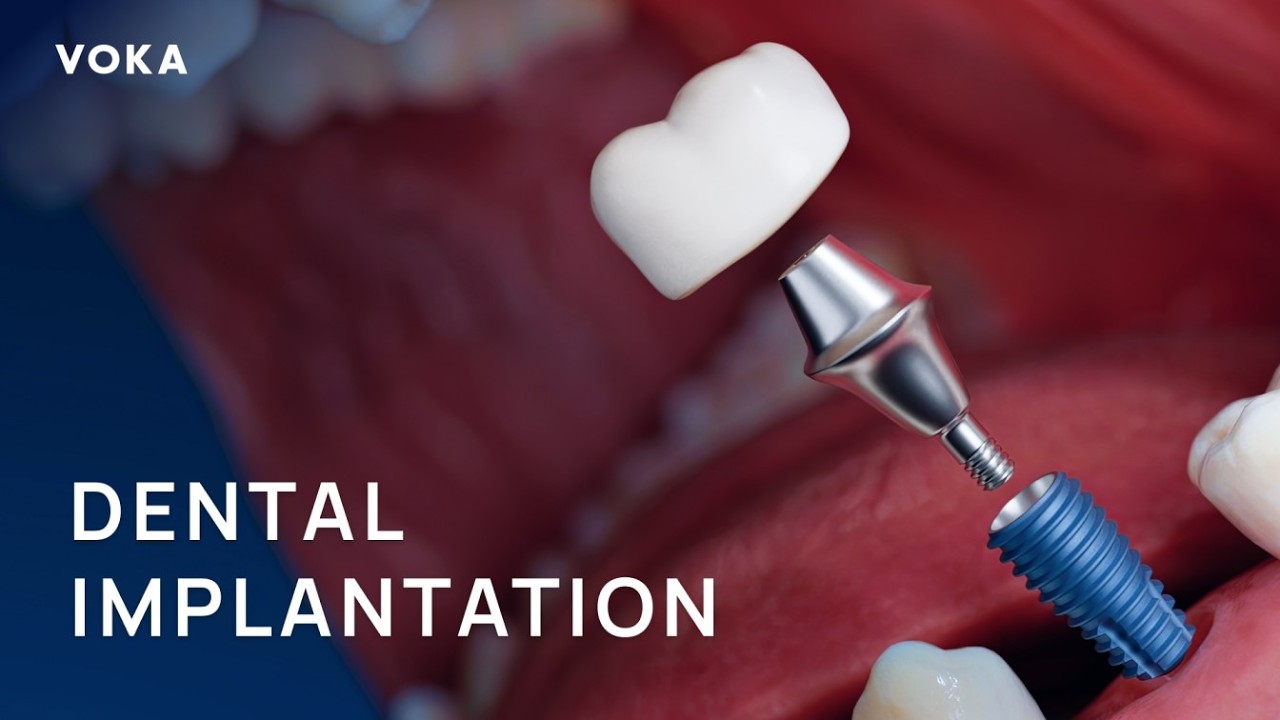
If adding “content creator” to your job title doesn’t sound appealing, you don’t have to do everything yourself. VOKA offers ready-made 3D dental models in its free VOKA 3D Anatomy & Pathology app, which you can explore and embed on your website or patient portal via an interactive 3D viewer.
Need something more specific? We can also create a custom dental video for your practice, or you can browse ready-made ones on our YouTube channel.
Local search and Google Business Profile
For many local searches, Google Maps is the shortest path to a phone call. When someone searches for “dentist near me,” the local results that show up in Maps can matter just as much as the practice website.
A strong local dental marketing presence starts with the basics:
-
Set the primary category correctly and add secondary categories only where they genuinely apply.
-
Use real photos of the office, team, and equipment. Refresh them regularly instead of relying on stock images.
-
Create pages for each procedure and location so there is something specific for Google to rank.
-
Keep your NAP consistent across the website, Google Business Profile, and directories, including suite numbers.
-
Claim the same NAP on Bing Places and Apple Business Connect, too. Both are free and give you another map presence.
-
Add real patient questions to the Q&A section and answer them from the practice.
-
Keep holiday and special hours up to date. Incorrect opening hours can easily cost you a call.
Common mistake: Spending time polishing the website while the Google Business Profile is half-filled, or adding keywords to the business name. The latter can also put the profile at risk of suspension.
The good news? Most of this can be managed for free:
-
Google Business Profile: manage your local profile, Maps presence, and Performance report.
-
Google Search Console: see which queries bring your site into search results.
-
Google Analytics 4: check what visitors do after they land on your site.
-
Bing Places for Business: claim and manage your local listing on Bing.
-
Apple Business Connect: manage how your practice appears on Apple Maps and in Siri.
-
Valentin.app: check Google results for a specific location and device without relying on your own personalized results.
Reviews & online reputation
Most patients will check the reviews before making the call. And when it comes to reviews, recent activity can matter more than a huge historical total: 40 reviews from three years ago can look less convincing than 12 from this quarter.
Here’s how you can make the review process easy:
-
Ask at the right moment, ideally in the office, when the patient has just had a good experience. Send the link while it’s still fresh.
-
Make it one click by using a direct Google review link or a QR code at checkout instead of asking patients to search for your practice.
-
Reply to every review.
-
Handle negative reviews in two steps: one calm public reply, followed by a private resolution. Never discuss clinical details publicly.
-
Reuse strong reviews as patient testimonials on your website, with the patient’s permission.
Common mistake: Getting a burst of reviews after a campaign and then going silent for six months, or making the process so complicated that patients never bother.
You can keep the setup simple, too:
-
Google Business Profile: get your review link and QR code, and manage replies.
-
Yelp for Business: claim and monitor your Yelp profile.
-
Facebook page: collect recommendations from the audience already following your practice.
-
Healthgrades: monitor your provider profile and patient reviews.
-
Your front desk team: sometimes the simplest option is best – have the front desk send the review link while the patient is still there.
Paid upgrade: Need to automate it? Tools such as Swell, Weave, Birdeye, Doctible, and Solutionreach can send review requests automatically and collect reviews in one place. They make more sense once the practice has more patients coming through each day than the front desk can reasonably message by hand.
Paid search & social ads
Paid ads are the fastest way to put your practice in front of potential patients, and one of the least durable channels. The traffic comes while you’re paying for it and stops when you stop paying.
Ads can make sense for a new practice, a new service, a seasonal gap, or a competitor opening nearby. They can also become an expensive way to cover for a weak Google profile or a front desk that struggles to turn calls into appointments.
If you’re going to pay for traffic, make it count:
-
Run separate campaigns for high-value services, instead of one broad “dentist” campaign.
-
Keep the ad, landing page, and offer aligned so patients get exactly what they expected.
-
Track calls from every campaign, as phone calls are often a key conversion for dental practices.
-
Add negative keywords to filter out irrelevant searches, such as jobs, student resources, DIY treatment, or free-care queries.
-
Set your budget limits before launch, including both a minimum worth spending and a maximum you won’t exceed.
Common mistake: Sending paid traffic to the homepage and celebrating a good CTR without checking whether the calls actually became visits.
A few platforms cover most paid campaigns:
-
Google Ads: run search and local ads for high-intent queries. Paid (auction).
-
Google Ads call reporting: use built-in call tracking that can help attribute calls to your campaigns. Free with the account.
-
Google Keyword Planner: find search terms and build negative-keyword lists. Free with the account.
-
Google Tag Manager: track form submissions, click-to-call actions, and other conversions. Free.
-
Microsoft Advertising: run search campaigns on Bing and import campaigns from Google Ads. Paid (auction).
-
Meta Ads Manager: use for local awareness and retargeting. Paid (auction).
Internal marketing & referrals

Some of your best opportunities are already in your patient list. A patient who has already been diagnosed, or someone who hasn’t visited in a while, is usually much easier to bring back than someone who has never heard of your practice.
A few habits can make a big difference:
-
Work through the unscheduled-treatment list every week, rather than letting diagnosed treatment sit there.
-
Run reactivation campaigns for patients who haven’t visited in 12-18 months. Give them a reason to return.
-
Ask for referrals at the right moment, ideally when a patient has just had a good outcome, not through a poster in the waiting room.
-
Treat phone answering as part of marketing: use a simple script and listen to call recordings to see where opportunities are being lost.
-
Consider a membership plan for uninsured patients, so “I don’t have insurance” doesn’t automatically end the conversation.
-
Keep recall reminders going only until the patient books, so they don’t keep receiving unnecessary messages.
Common mistake: Spending money on new patient acquisition while the recall list gets ignored and diagnosed treatment remains unscheduled.
You probably already have most of what you need:
-
Your practice management system: use the built-in recall and unscheduled-treatment reports to find patients who are due for a visit or have treatment they haven’t scheduled yet. No extra tool needed.
-
A spreadsheet: track who was contacted, when, and what happened. Free and easy to start with.
-
Your front desk team: call and text patients on those lists. No extra software required.
Paid upgrade: Tools such as Dental Intelligence, PracticeMojo, RevenueWell, and NexHealth can pull these lists, send messages, and track responses automatically.
Offline & community
Not every patient finds a practice through Google. Local events, partnerships, sponsorships, and direct mail can still help a practice become a familiar name in the community. The challenge is knowing whether that visibility brings patients in.
Offline marketing works best when it feels local and specific:
-
Give each activity a clear purpose: a school screening day, an employer lunch-and-learn, a team sponsorship, or a seasonal community drive.
-
Decide how you’ll track it before spending money: use a dedicated landing page, short link, QR code, or campaign code.
-
Let the clinician be part of the story, whether that’s through a community talk, screening event, or educational material. Patients better remember a person who helped them than a logo on a banner.
-
Target the area around your practice and repeat successful campaigns instead of sending a one-off postcard and calling it a day.
Common mistake: Sponsoring local events year after year without tracking whether they actually bring in new patients.
You can start with a few things:
-
USPS Every Door Direct Mail: reach every address on selected carrier routes without buying a mailing list. You pay for postage.
-
Canva: create postcards, screening-day flyers, and other print materials.
-
A campaign landing page + QR code or short link: give each offline activity its own destination so you can track responses. Use your existing website.
-
Google Business Profile: promote local events and community activities where people already find your practice.
Paid upgrade: Don’t want to handle the mailing yourself? SmartPractice and MVP Mailhouse offer dental-focused postcard design, targeting, and fulfillment.
What makes a dental marketing strategy work

A good dental marketing strategy connects marketing activity to what happens with patients: where they found the practice, whether they booked, whether they showed up, and what happened after the visit. It also looks beyond new patient acquisition and considers how marketing supports the patients already in the practice.
To see if your strategy is working, it should pass four basic tests:
-
It should be measurable. You need to know where patients came from, what they booked, and what happened after the appointment. Impressions and clicks can help, but they aren't the outcome.
-
It should be tied to a patient action. What’s the next step? Book an exam, call the practice, request a consultation, or schedule a specific treatment.
-
It should survive the front desk. Even strong marketing can lose a patient if calls go unanswered and follow-ups are slow. Marketing and patient intake shouldn’t be treated as completely separate processes.
-
It should work for existing patients, not only new ones. Recall, treatment acceptance, referrals, and additional services contribute to practice growth. If you focus only on bringing in new patients, you can miss a lot of opportunities with the patients you already have.
How to market a dental practice: building a plan and budget
A dental marketing budget doesn’t have to be huge to be useful. What matters more is knowing what you want that budget to achieve and how you will measure it.
For many practices, the starting point is to put around 5-10% of collections toward marketing, although the right number depends on the practice’s goals, location, growth stage, and how competitive the local market is.
The exact percentage matters less than what happens next. Before spending anything, build the plan backwards from the patients you want to attract.
1. Set your patient target
Be specific about what you want to achieve. “Get more patients” is too vague to build a useful plan around.
How many new patients do you want each month? Are you trying to fill empty chairs, grow a new practice, or bring in more patients for a specific service such as implants or orthodontics?
Your target should also reflect the type of patient you want. 10 new implant patients are not the same as 10 people looking for a routine cleaning. The marketing strategy, budget, and channels may be very different.
2. Work back to your cost per new patient
Once you know the target, figure out what you can reasonably spend to reach it.
For example, if you want 30 new patients a month and can spend $3,000 on marketing, your starting target is $100 per new patient. That does not mean every channel has to hit exactly $100. SEO may cost more upfront and keep working for years, while paid search can bring patients much faster.
It also helps to look at the value of a new patient beyond the first appointment. Someone who books a cleaning and later accepts periodontal treatment has a very different value to the practice than someone who comes in once and never returns.
3. Pick two or three channels
Dental marketing ideas are easy to collect; choosing between them is the hard part. You do not need to be everywhere. In fact, trying to manage every dental marketing channel at once is a good way to end up with six half-finished projects.
Choose two or three channels that match your goals and patient behavior. A new practice might prioritize local search and paid search. An established practice with a strong patient base might get more from referrals, reactivation, and treatment-focused content.
4. Assign the budget
Now divide the budget between those channels.
Do not split it evenly just because that looks neat on a spreadsheet. Put more money behind channels that have a clear role and enough data to show whether they are working.
It is also worth separating marketing spend from content and production costs. A custom dental animation, professional photography, or website project may be an occasional investment rather than a monthly marketing expense.
Start with a manageable budget, then adjust it as you learn what works. Marketing should be treated as an ongoing process.
5. Set a review cadence
Not every channel deserves to be judged on the same timeline.
Paid search can give you useful data within days or weeks. Local search and reviews need more time to show a pattern. Content and SEO can take months to build momentum, but the results can continue long after the initial work is done.
Set a regular review schedule before launching anything. A monthly check-in works well for paid campaigns and lead flow. Longer-term channels can be reviewed quarterly.
The goal is not to change the strategy every time one number moves. It is to spot patterns and decide where the next dollar or hour of work should go.
6. Track the key metrics
Once you start tracking results, it is easy to end up with a dashboard full of numbers and no idea what any of them mean. Keep the main metrics tied to the patient journey.
These metrics are more useful than looking at clicks or impressions in isolation. A paid campaign with a great CTR is not doing much for the practice if nobody books. And a procedure page with modest traffic may still be valuable if the people who find it are more likely to move forward with treatment.
7. Calculate your dental marketing ROI
Once you have enough data, you can start asking the question everyone eventually gets to: Did we actually make money from this?
A simple way to calculate marketing ROI is:
Marketing ROI = (revenue generated by marketing − marketing cost) / marketing cost × 100
For example, if you spend $3,000 on Google Ads and can attribute $9,000 in treatment revenue to patients acquired through those campaigns:
($9,000 − $3,000) / $3,000 × 100 = 200% ROI
That is a useful starting point, but don’t treat it as the whole picture. Revenue is not the same as profit, and a new patient may generate treatment revenue months after the first marketing interaction.
For a more realistic view, practices can also look at patient acquisition cost, revenue per new patient, and the value of patients over time. The more complete the data in your practice management system, the easier it becomes to connect a marketing source to an actual appointment and treatment outcome.
One more thing: give channels enough time to show what they can do. A Google Ads campaign can be judged relatively quickly. An SEO article may take months to build traffic, then keep bringing patients long after it is published. Comparing the two on the same timeline will make one look better than it really is.
Bottom line on dental marketing
You don’t need to use every dental marketing channel to grow a practice. Focus on the ones that match your goals and pay attention to what happens after a patient finds you. New patient numbers, cost per booked appointment, reactivation, treatment acceptance, and ROI give you a much clearer picture of performance than clicks or impressions alone.
If you are planning to invest more in patient education, VOKA can help with the visual side of it. Explore our 3D dental models and animations, and don’t hesitate to get in touch with our team if you have a specific idea in mind.
FAQ
1. What is dental marketing?
Dental marketing is how a dental practice attracts new patients, keeps existing ones engaged, and helps patients choose treatment. It can include SEO, paid ads, reviews, content, referrals, and community outreach.
2. How much should a dental practice spend on marketing?
There is no universal number, but many practices start with around 5-10% of collections. The right budget depends on your growth goals, location, competition, and how much new patient volume you need.
3. What software do dental practices use for marketing and patient education?
Most practices use a mix of tools rather than one platform. Common options include Google Business Profile, Google Analytics, practice management software, email or SMS tools, and visual platforms such as VOKA.
4. How do dentists get new patients without an agency?
Start with the basics: optimize your Google Business Profile, collect reviews, create useful procedure pages, and stay in touch with existing patients. You can manage many of these tasks in-house without a large marketing budget.
5. Why is my dental marketing not bringing in new patients?
The problem may not be the marketing itself. Check whether people can find your practice, whether your offer matches what they are searching for, and whether calls and inquiries are actually turning into appointments.
6. How long before dental marketing shows results?
It depends on the channel. Paid ads can generate inquiries within days or weeks, while SEO, content, and reviews usually take longer to build momentum.
7. How do you present a treatment plan so patients say yes?
Make the treatment easy to understand and connect it to the patient’s actual problem. Clear visuals, simple language, and a conversation about benefits, options, cost, and what happens next can make the decision easier.
Make VOKA your preferred source
See more VOKA articles in Google Search

Share
Table of contents

Thank you for your comment!
Your comment has been submitted for moderation and will be published soon. We'll email you once it’s live.