

XR in surgical training: virtual reality simulation, planning, and practice

Share:

Copy link

Share via Telegram

Share on Facebook

Share on LinkedIn

Share via WhatsApp

Share on X

Share via Email

Table of contents
Surgical training is not something that happens only by watching or reading. Residents and professionals need repeated hands-on practice. But real experience in the operating room is limited, and patient safety can’t be compromised.
So, how to close this gap? More and more hospitals and medical universities solve the issue by using XR in surgical training.
In this guide, the VOKA team shares how surgical XR works, where it delivers the most value, and what organizations should consider before implementing these technologies in medical education and training in 2026.
Key takeaways
1.
Surgical XR integrates VR, AR, and MR to support different stages of surgical training.
2.
Virtual reality is the main format for immersive training. It allows surgeons to repeat procedures and build technical skills.
3.
AR and MR are mainly used for surgical planning and intraoperative guidance.
4.
Most studies report that VR training improves technical performance, but results vary depending on training design and realism.
5.
XR works best as an additional layer on top of traditional surgical training, not a replacement.
6.
Even with strong potential, XR adoption still faces real-world challenges related to cost, realism, and validation.
What is XR in surgical practice?
Surgical XR (Extended Reality) is an umbrella term encompassing virtual reality (VR), augmented reality (AR), and mixed reality (MR) technologies integrated into medical education and operative workflows.
In 2026, surgical XR is primarily utilized for risk-free simulation-based training, patient-specific preoperative planning, and real-time intraoperative navigation.
XR technologies are used differently depending on the training needs:
-
Augmented reality overlays digital elements onto the real world. In surgery, AR can display CT scans, MRI data, or 3D anatomy directly within the surgeon’s field of view. As for AR in medical education, it allows surgeons to manipulate 3D models of organs and practice techniques while still being in their real-world surroundings.
-
Mixed reality blends physical and digital environments. Surgeons can interact with holographic 3D anatomy models while still seeing the real operating room and medical equipment around them.
-
Virtual reality creates a fully digital environment where surgeons can practice procedures in a simulated operating room. VR surgical training is commonly used for skills development and procedure rehearsal on virtual patients and 3D models of organs.
How VR, AR, and MR differ in surgery
The key difference is how each technology interacts with reality. VR fully replaces the real world, AR adds information on top of it, and MR combines both into one interactive setting.
Here’s a simple breakdown of how these technologies differ.
Why surgical training needs simulation-based learning
It’s important to note that simulation-based learning doesn’t replace the real operating room experience. Surgeons still need clinical practice, mentorship, and cadaver labs.
However, XR and virtual reality simulation are valuable additions to modern surgical training because they solve several limitations of traditional learning, and here’s how:
-
More opportunities for hands-on practice: Trainees can repeat procedures multiple times without depending on operating room availability or patient schedules.
-
Safer learning environments: Surgeons can practice complex techniques and make mistakes without putting patients at risk.
-
Exposure to rare or difficult cases: XR simulations make it possible to train on uncommon anatomy, rare conditions, and high-risk surgical scenarios that may not appear during regular clinical rotations.
-
Standardized surgical education: Simulation platforms provide consistent training scenarios and assessment criteria across hospitals and universities.
-
Objective performance feedback: Many XR surgical training systems track accuracy, timing, instrument handling, and procedural errors to support skills assessment.
Top 7 XR use cases in surgery & training
Extended reality supports many stages of surgical education and clinical practice. The table below summarizes how XR technologies are used for each scenario.
Now that we’ve covered the basics, let’s break down each use case in more detail.
Anatomy education
Even experienced surgeons sometimes need to refresh their understanding of anatomy and pathology, especially when they deal with rare or complex cases. XR technologies help with this by making anatomy easier to explore and revisit in an interactive way.
This approach improves:
-
Spatial understanding
-
Anatomical orientation
-
Memory retention
-
Recognition of rare or complex structures
VR allows users to study anatomy in fully immersive 3D environments, while AR and MR place digital anatomical 3D models into the real world.
For instance, the VOKA 3D Anatomy & Pathology app lets users project models into the real space from a mobile device, making it easier to refresh knowledge anywhere without needing specialized equipment.
Explore the human body in 3D with VOKA
Try the appSurgical skills training
One of the main applications of XR in healthcare is surgical skills development. VR surgical training allows surgeons and residents to practice technical skills before working with real patients.
In virtual environments, trainees can improve:
-
Hand movements
-
Instrument positioning
-
Suturing
-
Navigation
-
Coordination
Virtual reality surgical training is especially useful for repetitive practice. Users can repeat the same task many times, correct mistakes, and gradually improve precision and speed. This helps build confidence and muscle memory before entering the operating room.
XR-based training is widely used in laparoscopic, orthopedic, neurosurgical, and robotic surgery education, where technical accuracy is critical.
Procedure rehearsal
XR technologies also support surgical rehearsal. Instead of reviewing only scans or written protocols, surgeons can walk through operations step by step in interactive digital environments.
VR simulations help users better understand:
-
Surgical workflows
-
Operating room setup
-
Instrument sequencing
-
Anatomical challenges
-
Possible complications
Some platforms, like Surgical Theatre, also empower surgeons to rehearse with patient-specific CT or MRI data converted into 3D anatomy models.
Surgical planning and intraoperative guidance
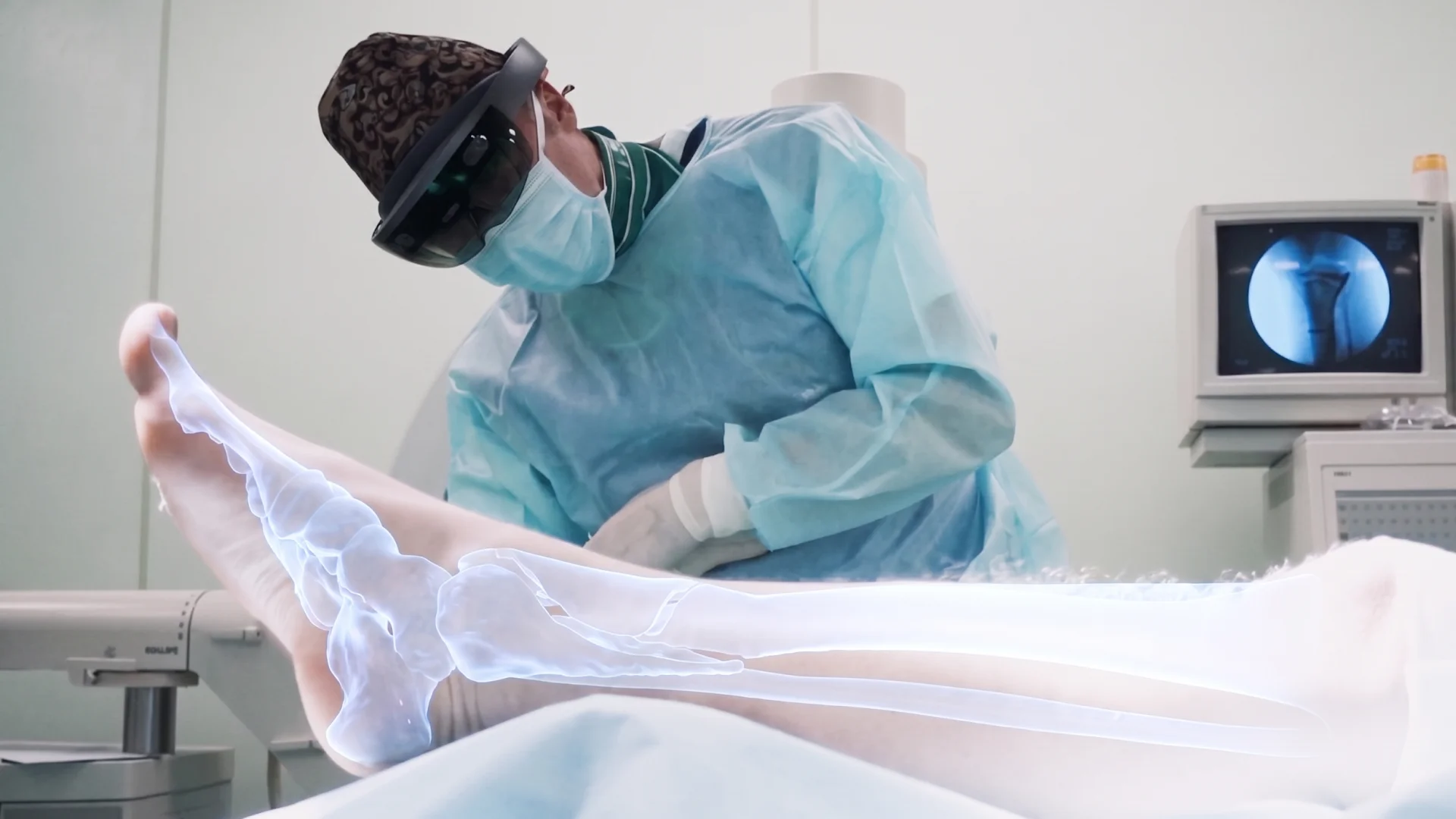
AR and MR are particularly useful for surgical planning and navigation. These technologies can display CT scans, MRI data, or patient-specific 3D anatomy directly within the surgeon’s field of view.
This helps surgeons to:
-
Visualize anatomy before surgery
-
Plan surgical access routes
-
Improve orientation during procedures
-
Identify critical structures more easily
In mixed reality environments, surgeons can interact with holographic anatomy models while still seeing the real operating room and instruments around them.
Such technologies are especially valuable in neurosurgery, orthopedic surgery, cardiac surgery, and other complex procedures where spatial precision is essential.
Haptic feedback and instrument handling
Some VR surgical training systems use haptic feedback to simulate the feeling of touching tissues or handling surgical instruments.
For example, FundamentalXR combines VR simulation with haptic devices to replicate force and resistance during procedures like bone drilling or suturing. Another example is SenseGlove, which provides force feedback through wearable gloves, allowing users to feel virtual objects and instrument interactions.
Using those, trainees can practice delicate movements, improve hand-eye coordination, and understand how instruments behave during surgery.
While current technology still can’t fully replicate real tissue sensation, modern haptic systems significantly improve immersion and skill development.
Communication and team training

XR is not only used for individual skill development, but also for training entire surgical teams. VR and MR environments allow surgeons, nurses, and operating room staff to practice together in shared simulated scenarios that replicate real clinical workflows.
This improves coordination during procedures, clarifies roles within the team, and reduces communication errors in high-pressure situations.
By rehearsing complex operations in a controlled setting, teams can align faster and perform more efficiently in the real operating room.
Performance tracking and standardized education
One major advantage of XR surgical simulation is the ability to track performance objectively. Training platforms can automatically measure:
-
Accuracy
-
Timing
-
Instrument movement
-
Error rates
-
Task completion
-
Procedural consistency
This provides immediate feedback after each training session and allows instructors to monitor progress more objectively.
Many hospitals and medical schools now integrate XR simulation into residency programs, simulation labs, and surgical curricula. Standardized training modules also help provide more consistent educational experiences across different institutions and training levels.
Real applications of surgical XR: notable cases
XR in surgery is no longer just “surgeons wearing futuristic headsets.” Hospitals are already using these technologies in real clinical cases.
Cardiac surgery
The Journal of Surgical Case Reports published a notable case where XR enabled surgeons to visualize patient-specific anatomy in unprecedented detail. A 73-year-old male patient was diagnosed with three-vessel coronary artery disease through CTA and coronary angiography. This condition required coronary artery bypass grafting (CABG) surgery.
To enhance preoperative planning, the surgical team employed an extended reality tool with a custom AI-driven algorithm to generate a patient-specific 3D model of the coronary arteries from the CTA data. This model provided an accurate anatomical and pathological representation of the patient's coronary system.
Integrating this 3D model into the XR platform enabled the surgical team to interact with a full 3D view of the patient's coronary anatomy during preoperative planning and intraoperative guidance. The XR tool augmented spatial orientation, facilitated precise localization of stenoses, and enhanced the surgeon’s operative proficiency.
Neurosurgery
Another groundbreaking case published in the Journal of Neurosurgery showcased how XR enhanced the treatment of a 59-year-old patient with a 3 cm intracerebral hemorrhage (ICH) in the thalamus.
Given the deep-seated location of the hemorrhage, the surgical team leveraged an extended reality platform to enhance both preoperative planning and intraoperative navigation. Using VR, they created a detailed 3D model of the patient’s brain, which allowed them to map out the optimal surgical trajectory and carefully avoid critical structures.
During the surgery, AR provided real-time visualization to ensure precise navigation to the hemorrhage site. This technology enabled a minimally invasive endoscopic approach and successful evacuation of the hemorrhage without causing additional brain injury. The patient tolerated the procedure well and demonstrated significant recovery within 11 months.
What research says about XR surgical training
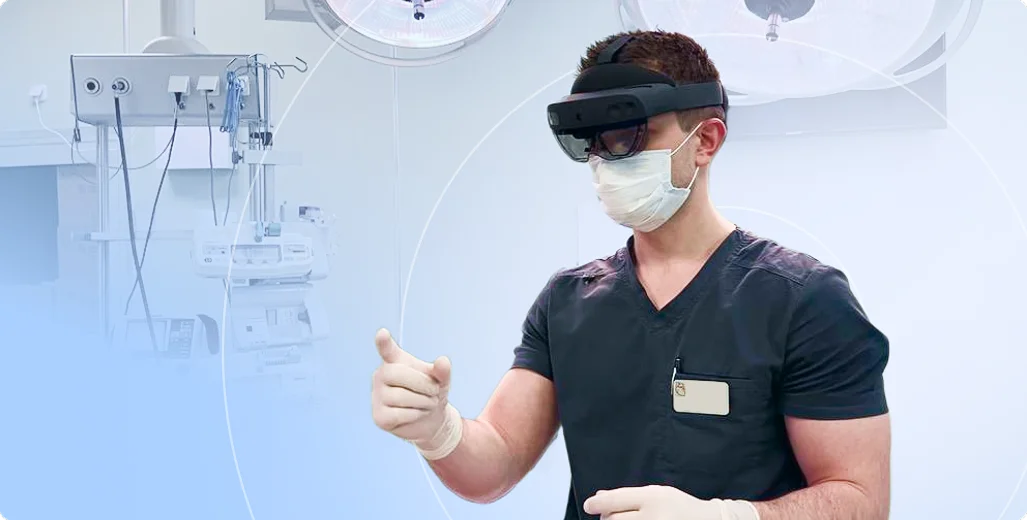
Research on XR in surgical training has grown quickly in recent years. Most studies look at whether simulation-based learning improves technical skills and how well these improvements carry over into real surgical practice.
Overall, results are promising: XR training tends to improve performance in simulated environments. But let’s dig a bit deeper.
Evidence for technical skill improvement
Multiple randomized controlled trials (RCTs) and meta-analyses show that VR-based surgical training improves technical performance, especially in early-stage learners.
A systematic review of RCTs in laparoscopic surgery found that learners trained with VR completed tasks faster, made fewer errors, and showed higher accuracy compared to no training or traditional methods. Similar results were confirmed across multiple controlled studies, particularly for novice surgeons.
A broader meta-analysis also reported significant improvements in structured performance scores (such as OSATS), task completion time, and error reduction after VR training interventions.
Overall, the evidence consistently supports one conclusion: VR improves technical skills in simulated environments and structured training programs, especially for beginners, but outcomes depend heavily on training design and realism.
Evidence gaps and clinical transfer
While the evidence for improved performance in XR environments is strong, there are still important research gaps.
Most studies measure simulation-based outcomes (speed, accuracy, and error reduction) inside the simulator. However, fewer studies confirm how consistently these improvements translate into real surgical performance in the operating room.
Another challenge is standardization. VR training systems differ in realism, tasks, and scoring methods, which makes it difficult to compare results across studies.
There is also limited long-term data on how XR training affects clinical outcomes, patient safety, and surgeon proficiency over time.
How to choose an XR surgical training solution
Despite the limitations of XR technologies, many of these challenges can be addressed with the right provider and a well-designed implementation approach.
The key is choosing a solution that is technologically advanced and grounded in clinical reality. Let’s discuss the factors you should consider.
-
Clinical validation: The solution should be developed or reviewed with medical experts to ensure anatomical and procedural accuracy. Without clinical validation, training results may not transfer reliably to real surgery.
-
Realism and workflow fit: The system should replicate real surgical workflows, not just isolated tasks. This includes procedure sequencing, OR dynamics, and decision-making scenarios that reflect clinical reality.
-
Technology capabilities: Different goals require different XR formats: VR for full procedural simulation, AR for real-world overlays, and MR for mixed interaction. Haptic feedback can further improve tactile realism.
-
Integration with existing systems: The solution should connect with LMS platforms, hospital IT systems, and analytics tools to track performance, learning progress, and competency over time.
Looking to develop custom VR/AR solutions for surgical training? The VOKA team can build tailored XR experiences that fit your needs – feel free to reach out to discuss your project.
Infrastructure and cost considerations
Choosing the right XR surgical training platform is not only about medical realism. Hospitals and universities also need to evaluate hardware, software, network infrastructure, and long-term implementation costs.
Modern VR surgical simulation often requires standalone headsets, compatible workstations, low-latency Wi-Fi 6E or 5G networks, and analytics systems to support smooth multi-user training without lag or motion discomfort.
Organizations should also decide whether they need an enterprise-ready surgical training platform or a custom XR solution tailored to specific procedures and workflows.
Key factors that affect implementation complexity and cost include:
-
VR headsets, tracking systems, and haptic devices
-
3D anatomy creation and medical content validation
-
Procedure complexity and level of interactivity
-
Multi-user or remote training functionality
-
LMS and hospital system integration
-
Analytics and performance tracking tools
-
Ongoing technical support and software updates
Examples of XR surgical training platforms
Below are real-world examples of the top VR tools for surgical planning and training in 2026, grouped by type of solution.
Latest advancements in healthcare mixed reality solutions (2026)
XR in surgery is moving fast – from basic “practice in a headset” setups to much smarter, more connected systems that actually feel closer to real clinical work. The next wave is all about better realism, more personalization, and tighter integration with hospital workflows.
Patient-specific simulation
One of the most important future directions is the shift toward fully patient-specific training environments. Using CT, MRI, and other imaging data, XR systems generates accurate digital replicas of individual patients. This allows surgeons to rehearse complex procedures on a “digital twin” before entering the operating room, improving preparation and reducing uncertainty.
Better haptics and physics-based interaction
XR systems significantly improve tactile realism. More advanced haptic devices and physics engines will better simulate tissue resistance, texture, and instrument behavior. This will make procedural training more precise and closer to real surgical experience, especially for delicate or high-risk interventions.
AI-assisted surgical training
Artificial intelligence makes XR training more adaptive and personalized. Systems help better detect errors, analyze performance patterns, and adjust scenarios in real time. This helps trainees focus on specific weaknesses and progress through customized learning paths rather than fixed modules.
Multi-user and remote simulation
XR increasingly supports collaborative and remote surgical training. Multiple users can join the same virtual environment from different locations, enabling real-time mentoring, team practice, and access to expert guidance regardless of geography. This will make high-quality surgical education more scalable and accessible.
Integration with surgical planning and navigation systems
In the future, the boundary between training, planning, and intraoperative support will continue to blur. XR platforms will be more tightly integrated with surgical planning tools and navigation systems, allowing the same 3D models used for rehearsal to be used directly in the operating room for guidance and decision support.
Wrapping up
XR medical training supports surgical education by overcoming the limits of traditional methods and making learning more hands-on. It allows surgeons to practice on a variety of cases in risk-free environments.
This technology, along with other interactive medical training solutions, is paving the way for safer and more innovative medical training. As XR continues to evolve, it will play an even more prominent role in medical education, helping surgeons gain the skills they need to deliver excellent patient care.
FAQ
1. Can XR surgical training replace cadaver labs or operating room experience?
No. XR is designed to complement, not replace, traditional surgical training. Cadaver labs and real operating room experience remain essential for understanding real tissue behavior, clinical decision-making, and teamwork under real conditions.
2. Is XR surgical training suitable for beginners, residents, or experienced surgeons?
Yes. XR can be adapted to all levels. Beginners use it for basic anatomy and foundational skills, residents for procedural training, and experienced surgeons for rehearsal of complex or rare cases.
3. Which surgical skills are best suited for virtual simulation?
Skills that benefit most from repetition and structured practice are ideal. These include suturing, instrument handling, laparoscopic coordination, navigation, and step-by-step procedural workflows.
4. How realistic can haptic feedback be in surgical simulation?
Haptic technology can simulate resistance, pressure, and basic tactile feedback, but it is still not fully equivalent to real tissue interaction. It is improving quickly, especially for structured tasks like suturing or drilling, but has limitations in highly complex tissue behavior.
5. Can XR surgical training be used remotely or in multi-user scenarios?
Yes. Many modern XR systems support multi-user environments where surgeons, trainees, and instructors can join the same simulation remotely for collaborative training and real-time feedback.
6. How are patient-specific 3D models created for surgical rehearsal?
They are generated from medical imaging data such as CT, MRI, or ultrasound scans. These images are processed, segmented, and converted into 3D anatomical models that can be used in VR or AR environments for rehearsal and planning.
7. What data can surgical simulation platforms track?
Most platforms track performance metrics such as accuracy, timing, instrument path, error rates, procedural steps completed, and consistency. Some also provide advanced analytics for skill progression and competency assessment.
8. How long does it take to develop a custom XR surgical training module?
It depends on complexity. Simple modules may take a few weeks, while highly detailed patient-specific or multi-procedure simulations can take several months, especially when clinical validation and advanced interaction are required.
9. What affects the realism of a surgical simulation?
Key factors include anatomical accuracy, quality of 3D models, physics simulation, haptic feedback quality, and how closely the virtual workflow matches real surgical procedures and operating room conditions.
10. Can XR surgical training be integrated with an LMS or hospital training system?
Yes. Many XR platforms are designed to integrate with learning management systems (LMS) and hospital IT infrastructure, allowing institutions to track progress, manage curricula, and standardize training programs.
11. Is special medical content validation required for XR surgical training?
Yes. Medical validation is critical to ensure anatomical correctness and procedural accuracy. Without clinical review, simulation outcomes may not be reliable for real-world training purposes.
12. What is the difference between off-the-shelf surgical simulators and custom XR training modules?
Off-the-shelf simulators offer ready-made training scenarios and are faster to deploy, while custom XR modules are tailored to specific procedures, institutions, or patient cases, offering higher realism and better alignment with specific training needs.
Make VOKA your preferred source
See more VOKA articles in Google Search

Share
Table of contents

Thank you for your comment!
Your comment has been submitted for moderation and will be published soon. We'll email you once it’s live.