

Virtual reality in pharma: applications and use cases

Share:

Copy link

Share via Telegram

Share on Facebook

Share on LinkedIn

Share via WhatsApp

Share on X

Share via Email
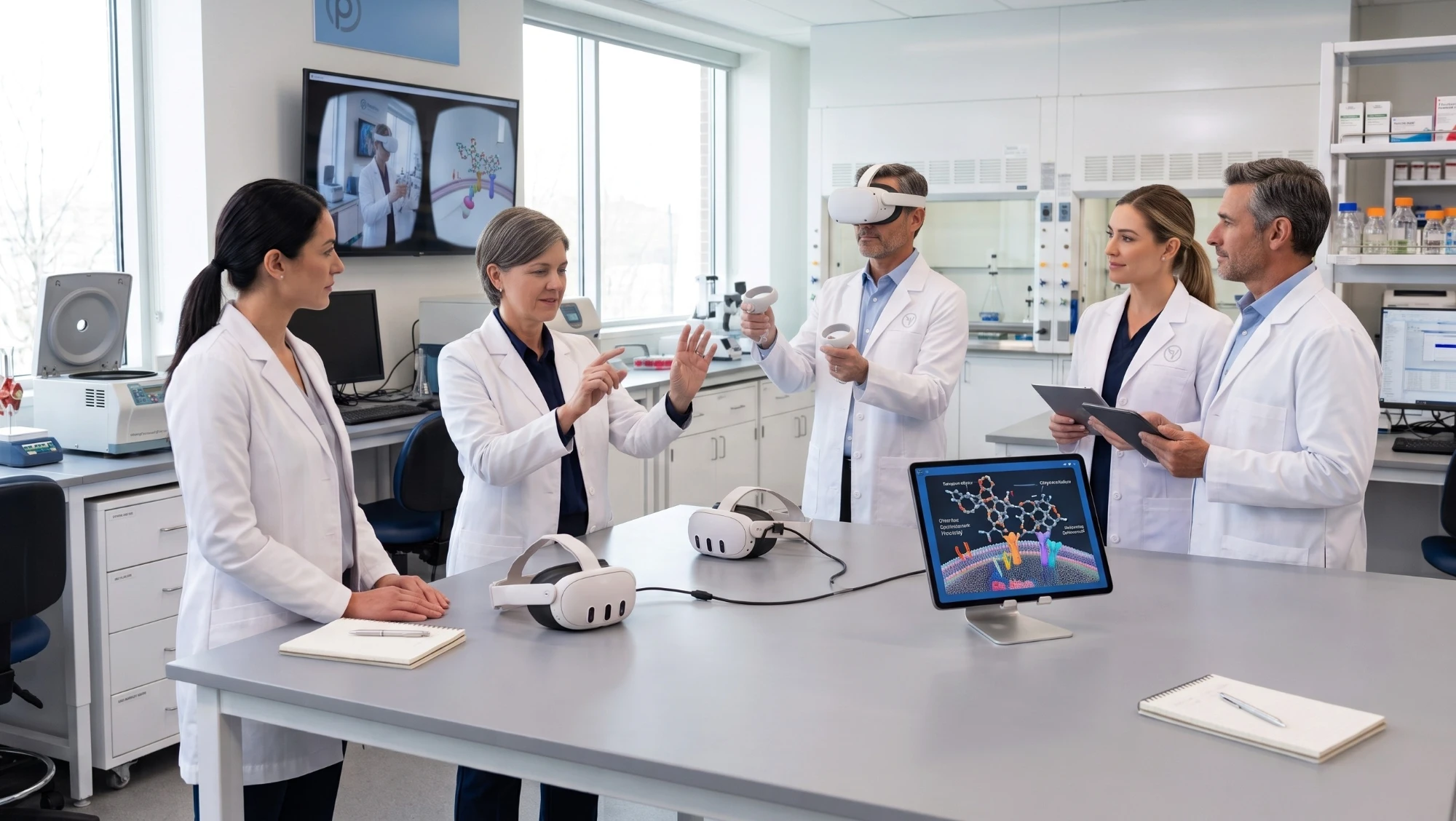
Table of contents
Virtual reality in pharma is no longer an experiment. Pharmaceutical companies use it to train cleanroom operators, walk teams through facilities that are not yet built, explore molecular structures, explain mechanisms of action to HCPs, and demonstrate products at congresses. In this article, we cover the five most prominent applications with examples and limitations for each.
To clarify, we talk only about a fully immersive VR with a headset, a simulated environment, and the ability to act inside it. It is not about the wider AR/VR cluster, or clinical VR therapy. If you are looking for the clinical side, see our overview of how VR is used in healthcare.
What is virtual reality in pharma?
Virtual reality in pharma uses a simulated, interactive environment that a person enters through a head-mounted display. Inside, an operator, a researcher, or an HCP can examine objects and processes, move through a space, and interact with the environment.
Three features separate VR from other digital formats:
-
Immersion – the headset replaces what the user sees and hears.
-
Spatial interaction – the user reaches, moves, and manipulates objects at real scale.
-
Agency – the virtual scenario reacts to what the user does.
Agency is what distinguishes VR from a 360° video and a standard 3D animation. In a 360° video, the viewer can look around but cannot change the experience. A standard 3D animation follows a fixed sequence from start to finish.
How is VR different from AR in pharma?
VR replaces the physical environment, and the user starts interacting with the simulation. AR overlays digital content onto the user's real-world environment.
So, if someone needs to rehearse a procedure before touching real equipment, or study a structure that does not physically exist at human scale, VR is the fit.
If someone is already at the machine and needs instructions, values, or a checklist in their line of sight, AR is the fit. That is why AR in pharma often appears in maintenance, line changeovers, and remote expert support.
We cover more use cases in detail in our separate article on augmented reality in pharma.
Key applications of virtual reality in the pharmaceutical industry
Five areas are the most prominent for VR applications. For each, we will cover the problem it solves, how exactly VR is applied, its practical value, and possible limitations.
Manufacturing and cleanroom training
In pharma, VR provides safe and controlled training. Access to a live production environment is scarce, expensive, and risky for a trainee. A virtual cleanroom is not.
Typical pharma VR training can cover the following topics:
-
Operator onboarding in classified areas;
-
Aseptic processing and gowning in Grade A/B areas;
-
Equipment handling;
-
Line clearance;
-
The sequence of steps described in standard operating procedures (SOPs).
Because the environment is simulated, trainees can also deliberately make mistakes. For example, they can experience a contamination event or miss a step without putting the facility, product, or production process at risk.
One of the clearest large-scale examples comes from Takeda. In the July 2025 case study, the company reports VR training at 13 sterile filling sites across three continents. The results are the following:
-
Roughly 10,000 VR training sessions a year;
-
A 20–30% reduction in training time for new joiners;
-
Up to a 5% reduction in production deviations.
The program is also integrated with Takeda's learning management system. It tracks training records against Good Manufacturing Practice (GMP) and multiple regulatory standards, including FDA requirements, EudraLex, and USP.
An independent study in Nature Biotechnology also provides useful insights on VR use in pharma training. It compared VR simulation with SOP reading and conventional hands-on training for aspiring biopharma operators learning a pH calibration procedure. The authors concluded that immersive VR simulations tailored to biopharma manufacturing operators could work as a cost-effective alternative to real-life training for practical skills.
In the study, VR reached about 79% of real-life training effectiveness. A later review notes that the knowledge scores showed no difference between the VR and real-life groups (Frontiers in Education, 2024). In other words, VR is a strong complement or partial substitute, not a proven replacement.
Additionally, from our experience, VR pharma manufacturing projects go better when they start with a single high-risk procedure rather than a whole curriculum. If you implement it at a single stage, you get an isolated module that tells you what the review cycle really costs. So you get real-world validation before committing to the full-scale VR implementation.
The possible limitation. VR does not deliver Good Manufacturing Practice compliance on its own. It only supports training. Compliance depends on validated content, a controlled change process, and a training system that produces auditable records. The Takeda example is vital because they treat an LMS integration as part of the solution, not an afterthought. So, budget for content validation and record-keeping from the start.
Virtual facility walkthroughs and process planning
VR lets teams explore facilities they cannot physically enter because they are on another continent, still under construction, or have restricted access.
Common applications include:
-
Virtual tours of plants and laboratories;
-
Remote walkthroughs for auditors and stakeholders;
-
Reviewing equipment placement, material flows, and personnel routes before anything is installed.
For new facilities, this is often the only way to rehearse a workflow and make changes at low cost.

It is important to distinguish between a digital twin and a standard VR experience. A digital twin means a model connected to live data from the real asset, updating as the asset changes. Many so-called "digital twin" VR projects in pharma are actually static 3D replicas. Both are legitimate, but cost differently and answer different questions. Therefore, a pharma company should be precise when asking for a related VR solution.
The possible limitation. A walkthrough is only as accurate as the source data. If the model comes from outdated drawings rather than fresh documentation or a laser scan, people will memorise a layout that does not exist. Plan for a model update cycle, especially if the facility is still being commissioned.
Laboratory training and pharmaceutical R&D
In R&D, VR is used mainly for laboratory training and for exploring molecular data in three dimensions.
Laboratory training can cover equipment familiarization, procedural sequences, and safe handling, similar to manufacturing training but in a laboratory setting.
The more distinctive use is molecular visualization. Proteins, binding pockets, and drug–target interactions are three-dimensional concepts that flatten badly on a monitor. In VR, a pharma chemist can investigate a binding site at human scale. Several people can also inspect the same structure together in a shared session.
One documented example comes from Nanome, a molecular VR platform that publicly lists Novartis and Genentech among its users. Its Nimbus Therapeutics case study describes computational chemists sharing 3D molecular designs with chemists and biologists who previously worked from 2D tools.
The possible limitation. Most of this evidence comes from vendor case studies and conference talks rather than peer-reviewed outcome data. These sources consistently report better discussion of spatial data. However, claims about shorter drug development timelines are not supported by published outcome data, and scientific audiences quickly notice overstatement.
HCP education and scientific communication
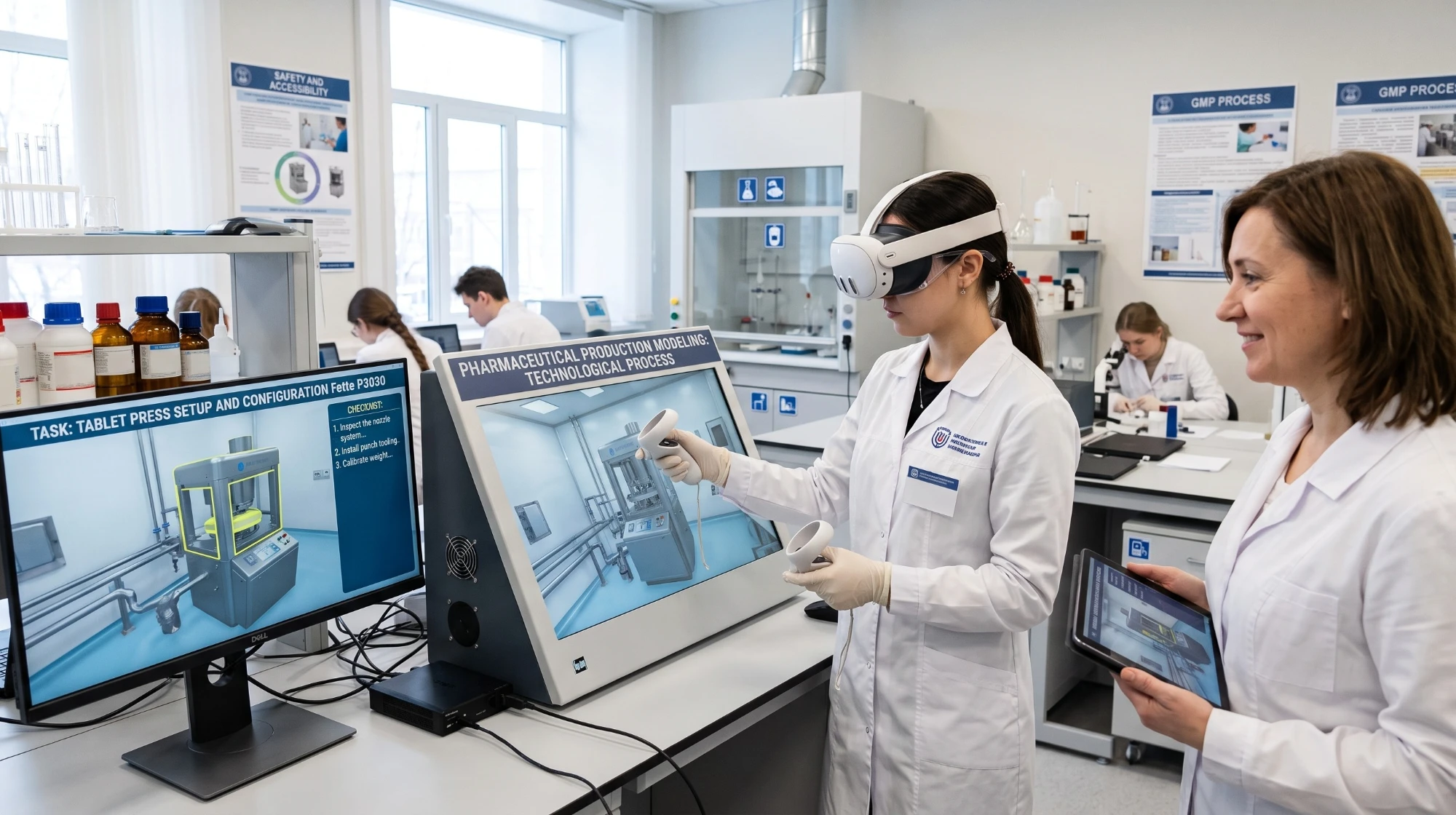
A key use case is explaining established science to a professional audience, such as HCPs, medical affairs teams, and internal sales staff.
Common topics include:
-
Mechanism of action;
-
Mechanism of disease;
-
Cellular and molecular process visualizations;
-
Drug–target interactions;
-
The progression of a condition over time.
Standard 3D animation can show the same processes, but VR adds immersion, scale, and interaction. A viewer can move inside a virtual vessel or a cell, follow a process step by step, and trigger explanations for the structure they are looking at.
This use case is also where scientific and medical content validation matters most, and where projects most often have problems.
In our experience, VOKA's review cycle with clinical experts regularly takes longer than 3D production itself. That extra review time is important because a visually convenient simplification can become scientifically wrong. The other thing we consider in every immersive build is that standalone headsets need a stable frame rate. You can’t simply drop assets from a cinematic-quality animation into a VR scene without rebuilding them for real-time format.
The possible limitation. A headset is a single-user device. Plan a VR scientific narrative alongside a non-immersive version, for example, a video, a web viewer, or a tablet build. Otherwise, its reach can be limited by the number of headsets available and the staff needed to manage them.
Product demonstrations, congresses, and pharma marketing
At a scientific event, VR can help attract attendees to a booth and allow the team to start a conversation. It can also help your booth to compete with dozens of others. Beyond the booth, virtual reality in pharma sales supports product launches and HCP presentations, letting reps walk a specialist through a device or MoA instead of describing it.
Applications include:
-
Virtual demonstrations of devices and delivery systems;
-
Immersive disease-state experiences;
-
Product guides at stakeholder conversations.
A well-documented example is the 2019 American Headache Society meeting. An interactive VR experience built for an Amgen and Novartis scientific affairs booth took headache specialists through the molecular basis of migraine as a virtual scavenger hunt with quiz questions. A physical 3D brain anchored the booth, and analytics tracking showed the client where the audience's knowledge gaps were. So, the VR experience also served as a measurement instrument.
It is worth noting that the most cost-efficient programs reuse the same 3D assets across the VR build, the congress screen loop, the MSL tablet, and the website. So the vital tip is to produce a scalable experience, one that can be deployed in many places.
The possible limitation. Headset logistics can become a real burden at a congress. Hygiene, charging, staffing, queue management, and a spectator screen require additional preparation. Factor these requirements into the booth plan and budget separately from VR content production.
Advantages and limitations of VR in pharma
Every advantage of VR comes attached to a condition. The honest way to present them is side by side.
Across virtual reality pharma programs, the pattern is the same: VR makes content easier to understand, but the effort shifts to preparation, validation, and logistics.
When is VR the right format for a pharma project?
VR is a good fit when the user has to perform actions, practice a procedure safely, move through a spatial environment, or handle a complex object.
If none of these interactions are essential, a non-VR format may be more practical. Still, you have to align the content to your needs:
-
Explaining a mechanism of action to a broad audience? A 3D MoA animation is easier to distribute, easier to approve, and works on any screen.
-
Guiding someone working on real equipment? AR overlays instructions on the working environment via a tablet or smart glasses, without replacing it.
-
Need access without hardware? Web-based interactive 3D reaches anyone via a browser with an adequate level of immersion.
Choosing the right format early can help avoid unnecessary production and development costs. VOKA's medical VR & AR development team can help you compare immersive options with alternatives and, once the format is defined, build a custom pharmaceutical VR experience.
Choosing VR for the right task, not for novelty
Across all five applications, VR delivers three kinds of value: safe practice in environments where mistakes are costly, spatial understanding of complex medical and scientific structures, and immersive scientific communication for professional audiences.
The technology has moved past the proof-of-concept stage in pharma, and examples like Takeda's 13-site program show it operating at industrial scale. It is not, however, a default format. VR earns its cost when immersion and interaction are required to accomplish a specific task, and loses it when they are added for novelty only. Many other content types can be as effective in specific circumstances.
FAQ
1. How is virtual reality used in the pharmaceutical industry?
In five main areas: manufacturing and cleanroom training, virtual facility walkthroughs and process planning, laboratory training and R&D visualization, HCP and scientific communication, and product demonstrations at events. Training is currently the most documented application.
2. What is the difference between VR and AR in pharma?
VR replaces the physical environment with a simulated one, so the user interacts with objects that are not there. AR adds digital content, such as instructions, data, or models, on top of the real environment the user is already in.
3. Can VR be used for pharmaceutical manufacturing training?
Yes, and it is the most established application. VR simulations let operators practice cleanroom behaviour, gowning, aseptic processing, and equipment handling before entering a classified area. But VR does not make training GMP-compliant by itself. Compliance comes from validated content, controlled updates, and a training system that produces auditable records.
4. What equipment is needed for a pharmaceutical VR experience?
It depends on the format. A standalone headset is the usual choice for training and congress use. A PC-connected headset makes sense for high-fidelity scenes such as detailed molecular data. Beyond the headset, plan for controllers or hand tracking and optional room tracking, if the scenario involves walking. Finally, to distribute and update content across devices, you will need a device management (MDM) platform, plus LMS integration if you need training records.
5. How can pharma companies measure the effectiveness of VR?
Choose metrics that match the goal. For training, these can be task completion, error rate, time to competency, knowledge retention after a delay, and operational outcomes such as deviation rates. For scientific communication, the metrics include time spent in the experience, questions asked afterwards, and follow-up engagement. Don’t treat engagement alone as proof of effectiveness, as it only measures users’ interest, not understanding.
Make VOKA your preferred source
See more VOKA articles in Google Search

Share
Table of contents

Thank you for your comment!
Your comment has been submitted for moderation and will be published soon. We'll email you once it’s live.